Showing posts with label Paul McAuley. Show all posts

Friday, 18 July 2025

Interzone 217/8 (2008)


I bought these back when I was trying to get a handle on the current state, as was, of the science-fiction short story. I went to Borders on Tottenham Court Road one Saturday afternoon and came back with the latest issues of Analog, Fantasy & Science Fiction, Asimov's Science Fiction magazine, and Interzone. Of these four, Interzone was the only homegrown publication, the others being American, and I'm afraid it didn't make much of an impression on me beyond that I liked it more than Analog - which isn't saying a lot. I'd hoped it would blow me away because, being English, I was rooting for the home team.

Revisiting issue 217 fifteen years later, I find that my initial impression remains more or less unchanged. There's nothing actually bad here, and it has its good points, but somehow it's difficult to get excited about any of this. A Google search for Karen Fishler, whose Africa somehow warranted the front cover, brought up only dimly related hits, mostly former readers opining that Interzone was way past its best and subscriptions would not be renewed. These gripes were from 2004 from what I could tell, so I don't know if this issue was more of the same, or even representative of a return to glory.

To get the grousing out of the way, the art is mostly knocked up on a computer and faintly unpleasant in the same way as early seventies art from that year when everyone discovered the airbrush, but never mind. The fiction is mostly decent, or at least readable. The aforementioned Karen Fishler's Africa reads somewhat like Jack Kirby at his most portentously cosmic without the pictures, which doesn't quite work for me. Paul G. Tremblay's The Two-Headed Girl and The Ships Like Clouds, Risen By Their Rain by Jason Sanford are both engagingly weird, but probably not quite enough to justify second or third helpings. Only Paul McAuley's Little Lost Robot had enough zing to pin his name to my inner corkboard for future reference. If Fishler was channeling Kirby, then Little Lost Robot has a strong hint of Pat Mills in its DNA and seemed to warrant my picking up his novel, Whole Wide World when I chanced upon a copy. I'd read his Eye of the Tiger a few years earlier and thought it was complete bollocks, and Whole Wide World was unfortunately not all I'd hoped it might be; so the best thing here is also the best thing I've read by an author whose work I haven't otherwise enjoyed - which hardly seems like a recommendation.

The review section devotes more pages to film and telly than seems entirely warranted, although said reviews are at least well written, beautifully argued, and certainly a cut above the mumbling generally found in the back pages of other digest magazines*; and Torchwood gets a filetting so thorough that I punched the air.

Sorry kids, but it was fucking garbage and anyone who enjoyed it should feel bad about themselves.

Actually, I'm not sorry in the slightest.

Despite the above, I somehow dutifully picked up the issue which followed, and despite the wonderful cover art by Warwick Fraser-Coombe, it's taken me fifteen years to get around to reading the thing - which is probably the fault of the previous issue.

Anyway, for what it may be worth, 218 is a little more convincing than 217, comprising six short stories which at least rate better than not actually bad - although Hannu Rajaniemi's His Master's Voice admittedly felt somewhat like every other box-ticking cyberpunk page filler I've ever read. This one was a Chris Beckett special, so we get three from him along with an interview which, I felt promised a lot more than his fiction delivered. It sounded great, but didn't quite come together in the pages which followed, although it's difficult to say quite why in so much as that Beckett's writing clearly did everything promised on the tin. My best guess is that it somehow felt like science-fiction written by a social worker, that being the author's day job. All the same, Rat Island, the last of the three, probably would have won me over had it been reproduced in isolation; or would have inspired a more vigorous winning over, I suppose I mean. There's enough here to warrant the assumption that he may well have written something amazing at some point.


*: Probably also a cut above the mumbling you're reading right now.

Tuesday, 15 December 2015

Whole Wide World


Paul McAuley Whole Wide World (2002)
I'm vaguely aware of Paul McAuley having written some Doctor Who novella which was supposed to be good, and although I've read it, I can't even remember what it was called at the moment. More recently his short story Little Lost Robot so impressed me when it turned up in an issue of Interzone as to leave his name lodged in my head when I saw this in the buy it cheap before we pulp the lot sale from which I picked up Beyond the Beyond, Little Fuzzy and others; so what the fuck, I concluded. Why not?

There was some initial hesitation on my part because I recall enjoying Little Lost Robot almost in spite of how it was written, which seemed kind of shrill and screechy with a suggestion of someone trying far too hard. Whole Wide World is similarly shrill and screechy but I realise this is simply how McAuley writes and it actually works once you get used to it, particularly in the context of a hard-boiled cop thriller such as what this is. Part of the screechiness manifests here as pop culture references specific to my generation, and the title itself is of course taken from Wreckless Eric. I have reservations about this sort of deal, just as all those New Adventures with chapters named after songs by the fucking Cure or the Smiths used to irritate the living shit out of me, even if the books themselves were decent, as they sometimes were. It's probably not the fault of the author, but I think it annoys me in apart because it's the sort of thing I used to do before I learned how to write - chuck in a few references to your fave band so everyone knows how cool you are and hopefully nobody will notice that you can't write; plus I'm still horrified by the continued existence of terminally beige Doctor Who authors of a certain vintage whose work these days mainly comprises hanging around on bulletin boards having opinions and making joking references to having once been a contender. If you're not sure what I mean here, just find some Who themed forum and look for threads debating which was the greatest Style Council album.

Anyway, it's irritating but McAuley just about gets away with it because the rest is so engaging as for you not to notice. Although that said, the novel is not without its problems in other respects. Amongst these, the most pronounced is probably it being centred around the inevitably gruesome murder of a teenage girl who, for the purpose of the plot, may as well be a prostitute. The video of her murder is all over the internet so as to make a number of somewhat blunt points about voyeurism, freedom of information, and so on; but the choice of victim tends to align the work with a thousand other lazily-drawn dramas in which we don't have to worry too much about the pivotal bucket of bloody innards because it was only a prostitute and was therefore probably complicit in its own murder by some means. So at heart, Whole Wide World may as well be Lynda La Plante with aspirations.

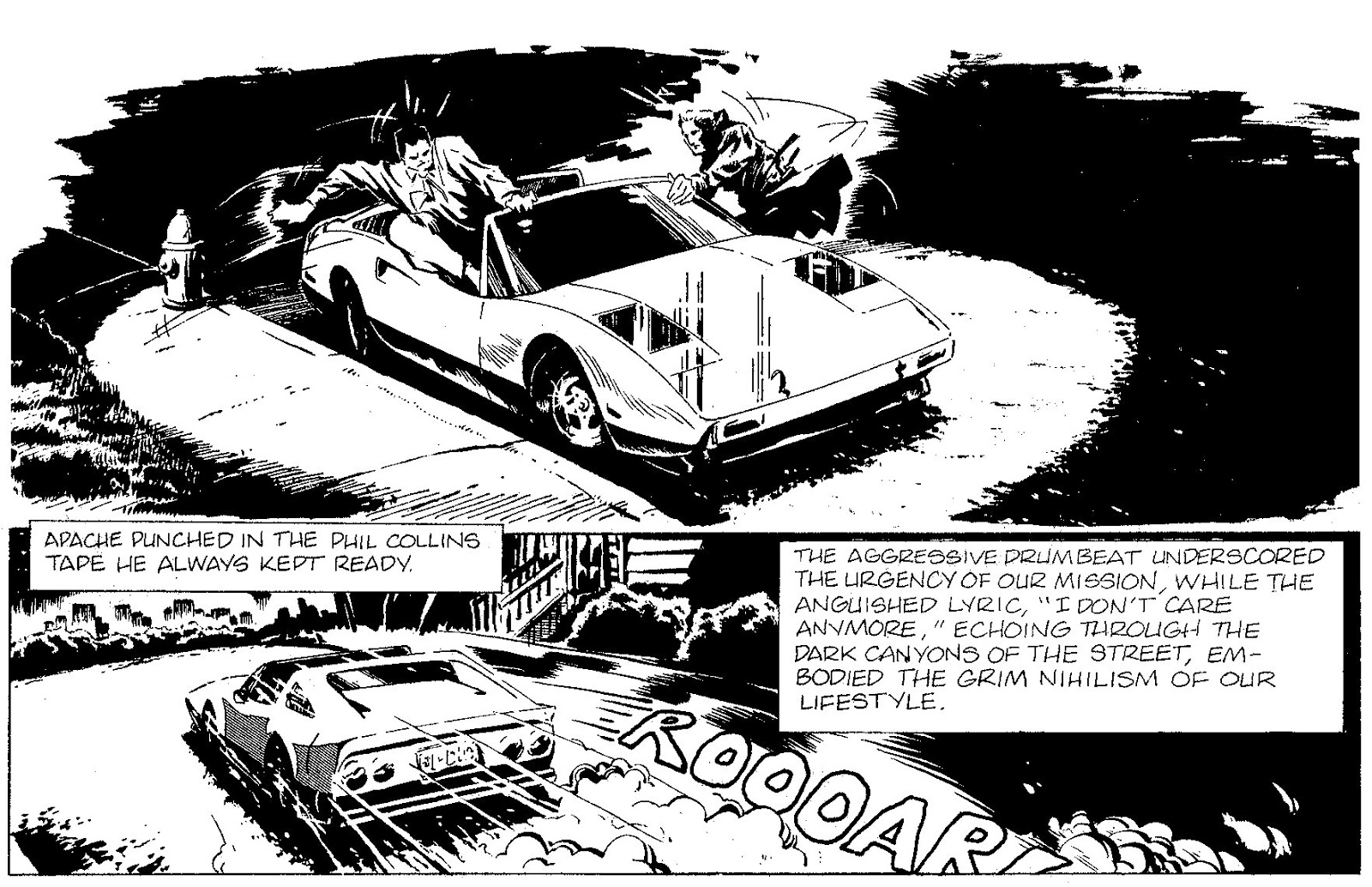
Some of those aspirations were apparently sufficiently advanced in 2002 as to justify this being published as a science-fiction, but most of the technology fetishised herein has since become commonplace, leaving the novel as a weird kind of period piece in which everyone still smokes in the pub. It sort of strains towards William Gibson, but just doesn't quite have the language; and by the time our man jumps in his car and blasts out his tape of the Clash, I couldn't keep myself from thinking of Lester Girls and Apache Dick with their beloved Phil Collins album in Gerard Jones' The Trouble with Girls:


Whole Wide World isn't bad of it's type, and is quite possibly above average of its type, so I wasn't bored, just occasionally disappointed. This is mainly because it isn't really about anything. It just sort of points at a stack of porn and a CCTV camera whilst pulling a knowing face, and that's your lot. Need I say more?

Yes, because you didn't actually finish the sentence, Paul.

Paul McAuley can obviously write. I just think he could afford to be a bit more ambitious than he is here, and a bit less like he's aiming for the airport book stand.