Stanley Schmidt (editor) Analog April 1980 (1980)
Just when you think you know someone… as Lord Rothermere observed on the first of September, 1939. I've developed certain expectations as I work my way through a handful of unread back issues of Analog picked up here and there over the years, and true to form, the April 1980 issue features a science article which I couldn't be bothered to read beyond the first couple of pages, Jerry Pournelle droning on about something or other, advertisements which appear faintly ludicrous with hindsight, and the second instalment of Bob Buckley's World in the Clouds - which would be fine if it were just about terraforming Venus as the science is quite interesting and well communicated, but said terraforming is undertaken as some kind of futuristic community service deal by a street tough. I assume tough as a noun made sense for my father's generation and I remember finding it weird in Topper and Beano when I was a kid. The problem is that, science aside, the rest of the tale is written in a style consistent with the kind of writing you would expect in a story about a street tough.
Also, there's David A. Roach's Memo from the Big Chief which takes the form of correspondence between various cavepersons - one of whom is imaginatively named Ugg - detailing, I presume, health and safety concerns raised by the invention of fire. I didn't read it because I make a point of not reading short stories which take the form of correspondence, and the premise just isn't that funny.
However, this was otherwise a surprisingly enjoyable issue of this thing. The characteristically right leaning editorial is fairly liberal and concerns itself with the environment in terms which serve to remind us that Republicans weren't always the largely amoral corporate shitbags we see before us today and were once worth listening to, sometimes. The letters page features satisfyingly testy missives from Poul Anderson, Isaac Asimov, and A.E. van Vogt defending his 1979 novel Renaissance from a reviewer who may or may not have bothered to read it.
The star attraction for me, the reason why this leapt off the shelf and into my hands, would be Simak's Grotto of the Dancing Deer which notably won Nebula, Hugo and Locus awards for best short story. Oddly, it's nothing spectacular in context of Simak's body of work, but is nevertheless decent - as you would most likely expect - so I suspect someone or other simply felt it was high time Cliff won another award, which is fair.
Finally we have the novella length Nightflyers, an example of George R.R. Martin's early science-fiction work. I sort of enjoyed the first couple of seasons of Game of Thrones, but not enough to read the books so this is my first encounter with his writing, and it's not difficult to see why he would eventually be shifting this stuff by the truckload. Nightflyers almost mashes a ghost story up with a murder mystery and flings the results out into deep space, and is of sufficient complexity and sophistication to oblige me to re-read the first half when I came back to it because I was already lost; and yet going back to start again turned out to be a genuine pleasure, such is the quality of the tale, which may even be the best thing I've read in any of these digest magazines. At least I can't, off the top of my head, think of anything I've enjoyed more.
I appreciate that even a stopped clock is correct twice a day - unless it's digital - but this one has made for a very pleasant change to the usual.
Showing posts with label Poul Anderson. Show all posts
Friday, 26 April 2024
Analog April 1980
Tuesday, 12 November 2019
Fantasy & Science Fiction 471
Edward L. Ferman (editor) Fantasy & Science Fiction 471 (1990)
Occasionally I've had cause to search for a particular issue of Fantasy & Science Fiction on Google, and for some weird reason this always seems to be the first issue which comes up as an image, regardless of whether or not it relates to my search; so when I happened upon a second-hand copy, I could hardly not buy it. The universe had obviously been trying to tell me something.
What it was apparently trying to tell me is that I probably should have been buying this thing regularly. I've always been reluctant to commit to the digests given that I always have more than enough to read as it is, but on the other hand, based on the five or six issues of this magazine which I've now read, I might have to make it a regular purchase, or at least splash out on a few more back issues. I always seem to pick it out when whatever I've just finished reading has turned out to be a bit of a slog, and due to some apparently subconscious belief that Fantasy & Science Fiction probably won't let me down; and, Robert Silverberg notwithstanding, it never has. It's short, snappy, suggestive of serious care and attention in the editorial department, always with one or two surprises, and with enough going on to reduce the impact of an occasional bum note.
This 1990 issue may not be life-changing, but it scores pretty high. Firstly we have Ian Watson's In the Upper Cretaceous with the Summerfire Brigade, which is mostly great - weird and yet breezy with just the right kind of bizarre delivered in casual fashion; and Daryl Gregory's In the Wheels, a vivid tale of voodoo road racing in rural post-apocalypse America, is sufficient to get his name on the list of authors of whom I need to read more. Then we have The Three Wishes by John Morressy in which elves and fairies find themselves stalled by bureaucracy, which is very funny and so ingenious as to make it seem crazy that no-one thought of it before. We Were Butterflies by Ray Aldridge is a bit of a mess but with a nevertheless powerful story in there somewhere. His Spirit Wife by Karen Haber is decent and moody, and Asimov's science column is, as ever, excellent. Finally there's Gregg Keizer's Days of Miracle and Wonder which is actually a pretty tough read, given the subject matter, but worth the effort.
For the sake of balance, Herself by Katherine Newlin Burt, first published in 1930, lays it on a bit thick and the prose is like wading through treacle; and something about Ian Watson's Asian characters doesn't sit right and ends up seeming faintly insulting. It's nice that Watson was shaking a fist at those who want to send them all back, but unfortunate that his Asian characters all turn out to be terrorists, somewhat conforming to stereotypes favoured by those who want to send them all back. Further along the line we have a couple of pages of nutters objecting to something Asimov wrote in a previous issue, a couple of which use the term liberal as a pejorative, so fuck those guys; and Poul Anderson for praising Margaret Thatcher. So that's a couple of bum notes, but the rest of the song is of such quality that there doesn't seem to be much room for complaint.
Occasionally I've had cause to search for a particular issue of Fantasy & Science Fiction on Google, and for some weird reason this always seems to be the first issue which comes up as an image, regardless of whether or not it relates to my search; so when I happened upon a second-hand copy, I could hardly not buy it. The universe had obviously been trying to tell me something.
What it was apparently trying to tell me is that I probably should have been buying this thing regularly. I've always been reluctant to commit to the digests given that I always have more than enough to read as it is, but on the other hand, based on the five or six issues of this magazine which I've now read, I might have to make it a regular purchase, or at least splash out on a few more back issues. I always seem to pick it out when whatever I've just finished reading has turned out to be a bit of a slog, and due to some apparently subconscious belief that Fantasy & Science Fiction probably won't let me down; and, Robert Silverberg notwithstanding, it never has. It's short, snappy, suggestive of serious care and attention in the editorial department, always with one or two surprises, and with enough going on to reduce the impact of an occasional bum note.
This 1990 issue may not be life-changing, but it scores pretty high. Firstly we have Ian Watson's In the Upper Cretaceous with the Summerfire Brigade, which is mostly great - weird and yet breezy with just the right kind of bizarre delivered in casual fashion; and Daryl Gregory's In the Wheels, a vivid tale of voodoo road racing in rural post-apocalypse America, is sufficient to get his name on the list of authors of whom I need to read more. Then we have The Three Wishes by John Morressy in which elves and fairies find themselves stalled by bureaucracy, which is very funny and so ingenious as to make it seem crazy that no-one thought of it before. We Were Butterflies by Ray Aldridge is a bit of a mess but with a nevertheless powerful story in there somewhere. His Spirit Wife by Karen Haber is decent and moody, and Asimov's science column is, as ever, excellent. Finally there's Gregg Keizer's Days of Miracle and Wonder which is actually a pretty tough read, given the subject matter, but worth the effort.
For the sake of balance, Herself by Katherine Newlin Burt, first published in 1930, lays it on a bit thick and the prose is like wading through treacle; and something about Ian Watson's Asian characters doesn't sit right and ends up seeming faintly insulting. It's nice that Watson was shaking a fist at those who want to send them all back, but unfortunate that his Asian characters all turn out to be terrorists, somewhat conforming to stereotypes favoured by those who want to send them all back. Further along the line we have a couple of pages of nutters objecting to something Asimov wrote in a previous issue, a couple of which use the term liberal as a pejorative, so fuck those guys; and Poul Anderson for praising Margaret Thatcher. So that's a couple of bum notes, but the rest of the song is of such quality that there doesn't seem to be much room for complaint.
Monday, 6 November 2017
The Best from Fantasy & Science Fiction
Robert P. Mills (editor)
The Best from Fantasy & Science Fiction eleventh series (1962)
Rightly or wrongly, I've always had the impression of Fantasy & Science Fiction as the American analogy to New Worlds, roughly speaking, at least in relation to Analog, Amazing, Galaxy, and the other magazines. Whilst you could usually expect a short story involving rockets and another involving alien civilisations from most of them, Fantasy & Science Fiction seemed to be the one to publish the weird stuff which didn't really fit anywhere else. That being said, I expected to enjoy this collection more than I did.
In its favour there are characteristically wonderful contributions from Clifford D. Simak and Poul Anderson, while Cordwainer Smith and Avram Davidson have both written impressively peculiar tales of quality sufficient as to suggest that I really need to hunt down a few more by those two. Then there's an underwhelming early work by Kurt Vonnegut Jr., something by Isaac Asimov which is probably about as whelming as I expected it to be, and my first encounter with Gordon R. Dickson which at least suggests that I've been wise to steer clear of anything with his name on the cover. George by John Anthony West is okay, and then there are another five tales listed in the index which I know I read but about which I can't remember a single thing; plus there's a couple of poems which weren't really my sort of thing.
Still, I suppose this kind of deal will always be very much like a box of chocolates in so much as that you never know which one you're gon' git, excepting cases of it being one of those boxes of chocolates wherein the various flavours featured amongst the selection are quite clearly denoted on the inside of the lid. They can't all be amazing, I guess, but it's nice that some of them are. Maybe they were just having an off year.
Rightly or wrongly, I've always had the impression of Fantasy & Science Fiction as the American analogy to New Worlds, roughly speaking, at least in relation to Analog, Amazing, Galaxy, and the other magazines. Whilst you could usually expect a short story involving rockets and another involving alien civilisations from most of them, Fantasy & Science Fiction seemed to be the one to publish the weird stuff which didn't really fit anywhere else. That being said, I expected to enjoy this collection more than I did.
In its favour there are characteristically wonderful contributions from Clifford D. Simak and Poul Anderson, while Cordwainer Smith and Avram Davidson have both written impressively peculiar tales of quality sufficient as to suggest that I really need to hunt down a few more by those two. Then there's an underwhelming early work by Kurt Vonnegut Jr., something by Isaac Asimov which is probably about as whelming as I expected it to be, and my first encounter with Gordon R. Dickson which at least suggests that I've been wise to steer clear of anything with his name on the cover. George by John Anthony West is okay, and then there are another five tales listed in the index which I know I read but about which I can't remember a single thing; plus there's a couple of poems which weren't really my sort of thing.
Still, I suppose this kind of deal will always be very much like a box of chocolates in so much as that you never know which one you're gon' git, excepting cases of it being one of those boxes of chocolates wherein the various flavours featured amongst the selection are quite clearly denoted on the inside of the lid. They can't all be amazing, I guess, but it's nice that some of them are. Maybe they were just having an off year.
Tuesday, 2 May 2017
Journey to the Goat Star
Brian Aldiss Journey to the Goat Star (1991)
This was quite a nice find, just fifty pages and evidently one of a series of short stories published by Pulphouse as self-contained paperbacks, others in the range having been by Poul Anderson, Michael Bishop, Joe Haldeman and so on. That said, I've generally loved the novels of Brian Aldiss whilst hating most of his short stories for one reason or another, but every so often he comes out with one which reads like a novel, or which is at least bereft of Space Vikings or special kinds of atom. Journey to the Goat Star probably isn't quite top ten, but it's weird enough to be worth a look. Our story opens with a theoretical physicist brained at his writing desk by a burglar, a burglar who, noticing that which the theoretical physicist was writing, waits for his victim to come round and then engages him in debate on the subjects of matter as consciousness and the nature of reality as supposedly examined in the art of Georges Braque.
He turned earnestly back into the room, gesturing with his hands. 'Braque's shadows have substance, while the whole substance suddenly turns out to be a shadow of it. Forms are flattened, flatness has form. Planes merge, what is opaque becomes transparent and vice versa. Lines define nothing, yet everything is defined. If that isn't a vivid picture of contemporary science—execute before the first World War—then I don't know what is...'
This is also a description of how Aldiss tells the story, roughly speaking, which blends seemingly unrelated scenarios into one another - the forty-six year voyage to a distant star, psychoanalysis of a child rejected by parents - using coincidence and repeating thematic patterns to imagine our first meeting with an extraterrestrial intelligence. At least I think that's what it does. Journey to the Goat Star is bewildering and yet somehow left me with the feeling of having understood something, even if the above is as good a description as I can manage. It also makes me wonder if I've been expecting too much traditional sense from those of his other short stories which I found such a chore. Maybe I need to take another look.
Wednesday, 3 February 2016
The Greks Bring Gifts
Murray Leinster The Greks Bring Gifts (1964)
The more Leinster I read - although I should probably point out that this is only my third - the more I suspect his legend should loom at least a little larger than is presently the case. I'm not sure if he quite qualifies as a great lost master, but he's seriously fucking readable for someone you've probably never heard of, and I've yet to encounter a Murray quite so disappointing as certain crimes against fiction committed by numerous better established authors - Isaac Asimov, Poul Anderson and the rest.
The Greks Bring Gifts is, as you may have guessed from the title, the story of the alien Greks arriving on earth to share the bounty of their advanced technology with us humans, but the gifts come with a price and it turns out that the Greks are complete cunts. It's almost an allegory for everything ever done by white people when arriving in foreign lands populated by persons without television, although I'm not sure the parallels are deliberate so much as that this is a tale hung from the same basic lesson - something it shares with the more recent Singularity Sky by Charles Stross from what I can recall. The story is related in the comfortable tones of an elderly neighbour spinning tales from his stoop on a warm evening, following its protagonists along a detective trail of alien technology, archaeology, and the ethics of slavery. The FBI turn up to lend a helping hand from time to time, contributing to a feeling that The Greks Bring Gifts could quite easily have been an episode of The Outer Limits, I suppose deriving from an era in which government agency was held to be something you could trust at least some of the time.
I may have made the book sound unambitious or even a little dull, but the appeal is in the telling, and Leinster had a wonderful voice. By some terms he might be regarded as a hack or simply a pulp author, churning out genre fiction across the board under a variety of different pseudonyms, one after the other; but then it can hardly be denied that he'd put in the man hours and was very, very good at his craft. His conversational narrative draws you in immediately, and keeps hold for...
Well, I have to admit, this one seemed to slacken off at about the half way mark. It isn't that it lost the plot so much as that I had a feeling of characters trying to keep themselves busy until the big pay off at the end of the book. I wonder if this might be a clue as to Leinster no longer being quite the name he once was, namely that he was simply better at the short form and was less able to sustain momentum at novel length. My previous Murrays have been a short story collection and a novel which turned out to be three short stories utilising the same character. It isn't that The Greks Bring Gifts is in any sense bad, just that it feels a little like the author would have been happier writing something with less of a page count. I'm still going to be keeping an eye out for more from this guy.
The more Leinster I read - although I should probably point out that this is only my third - the more I suspect his legend should loom at least a little larger than is presently the case. I'm not sure if he quite qualifies as a great lost master, but he's seriously fucking readable for someone you've probably never heard of, and I've yet to encounter a Murray quite so disappointing as certain crimes against fiction committed by numerous better established authors - Isaac Asimov, Poul Anderson and the rest.
The Greks Bring Gifts is, as you may have guessed from the title, the story of the alien Greks arriving on earth to share the bounty of their advanced technology with us humans, but the gifts come with a price and it turns out that the Greks are complete cunts. It's almost an allegory for everything ever done by white people when arriving in foreign lands populated by persons without television, although I'm not sure the parallels are deliberate so much as that this is a tale hung from the same basic lesson - something it shares with the more recent Singularity Sky by Charles Stross from what I can recall. The story is related in the comfortable tones of an elderly neighbour spinning tales from his stoop on a warm evening, following its protagonists along a detective trail of alien technology, archaeology, and the ethics of slavery. The FBI turn up to lend a helping hand from time to time, contributing to a feeling that The Greks Bring Gifts could quite easily have been an episode of The Outer Limits, I suppose deriving from an era in which government agency was held to be something you could trust at least some of the time.
I may have made the book sound unambitious or even a little dull, but the appeal is in the telling, and Leinster had a wonderful voice. By some terms he might be regarded as a hack or simply a pulp author, churning out genre fiction across the board under a variety of different pseudonyms, one after the other; but then it can hardly be denied that he'd put in the man hours and was very, very good at his craft. His conversational narrative draws you in immediately, and keeps hold for...
Well, I have to admit, this one seemed to slacken off at about the half way mark. It isn't that it lost the plot so much as that I had a feeling of characters trying to keep themselves busy until the big pay off at the end of the book. I wonder if this might be a clue as to Leinster no longer being quite the name he once was, namely that he was simply better at the short form and was less able to sustain momentum at novel length. My previous Murrays have been a short story collection and a novel which turned out to be three short stories utilising the same character. It isn't that The Greks Bring Gifts is in any sense bad, just that it feels a little like the author would have been happier writing something with less of a page count. I'm still going to be keeping an eye out for more from this guy.
Tuesday, 15 December 2015
Whole Wide World
Paul McAuley Whole Wide World (2002)
I'm vaguely aware of Paul McAuley having written some Doctor Who novella which was supposed to be good, and although I've read it, I can't even remember what it was called at the moment. More recently his short story Little Lost Robot so impressed me when it turned up in an issue of Interzone as to leave his name lodged in my head when I saw this in the buy it cheap before we pulp the lot sale from which I picked up Beyond the Beyond, Little Fuzzy and others; so what the fuck, I concluded. Why not?
There was some initial hesitation on my part because I recall enjoying Little Lost Robot almost in spite of how it was written, which seemed kind of shrill and screechy with a suggestion of someone trying far too hard. Whole Wide World is similarly shrill and screechy but I realise this is simply how McAuley writes and it actually works once you get used to it, particularly in the context of a hard-boiled cop thriller such as what this is. Part of the screechiness manifests here as pop culture references specific to my generation, and the title itself is of course taken from Wreckless Eric. I have reservations about this sort of deal, just as all those New Adventures with chapters named after songs by the fucking Cure or the Smiths used to irritate the living shit out of me, even if the books themselves were decent, as they sometimes were. It's probably not the fault of the author, but I think it annoys me in apart because it's the sort of thing I used to do before I learned how to write - chuck in a few references to your fave band so everyone knows how cool you are and hopefully nobody will notice that you can't write; plus I'm still horrified by the continued existence of terminally beige Doctor Who authors of a certain vintage whose work these days mainly comprises hanging around on bulletin boards having opinions and making joking references to having once been a contender. If you're not sure what I mean here, just find some Who themed forum and look for threads debating which was the greatest Style Council album.
Anyway, it's irritating but McAuley just about gets away with it because the rest is so engaging as for you not to notice. Although that said, the novel is not without its problems in other respects. Amongst these, the most pronounced is probably it being centred around the inevitably gruesome murder of a teenage girl who, for the purpose of the plot, may as well be a prostitute. The video of her murder is all over the internet so as to make a number of somewhat blunt points about voyeurism, freedom of information, and so on; but the choice of victim tends to align the work with a thousand other lazily-drawn dramas in which we don't have to worry too much about the pivotal bucket of bloody innards because it was only a prostitute and was therefore probably complicit in its own murder by some means. So at heart, Whole Wide World may as well be Lynda La Plante with aspirations.
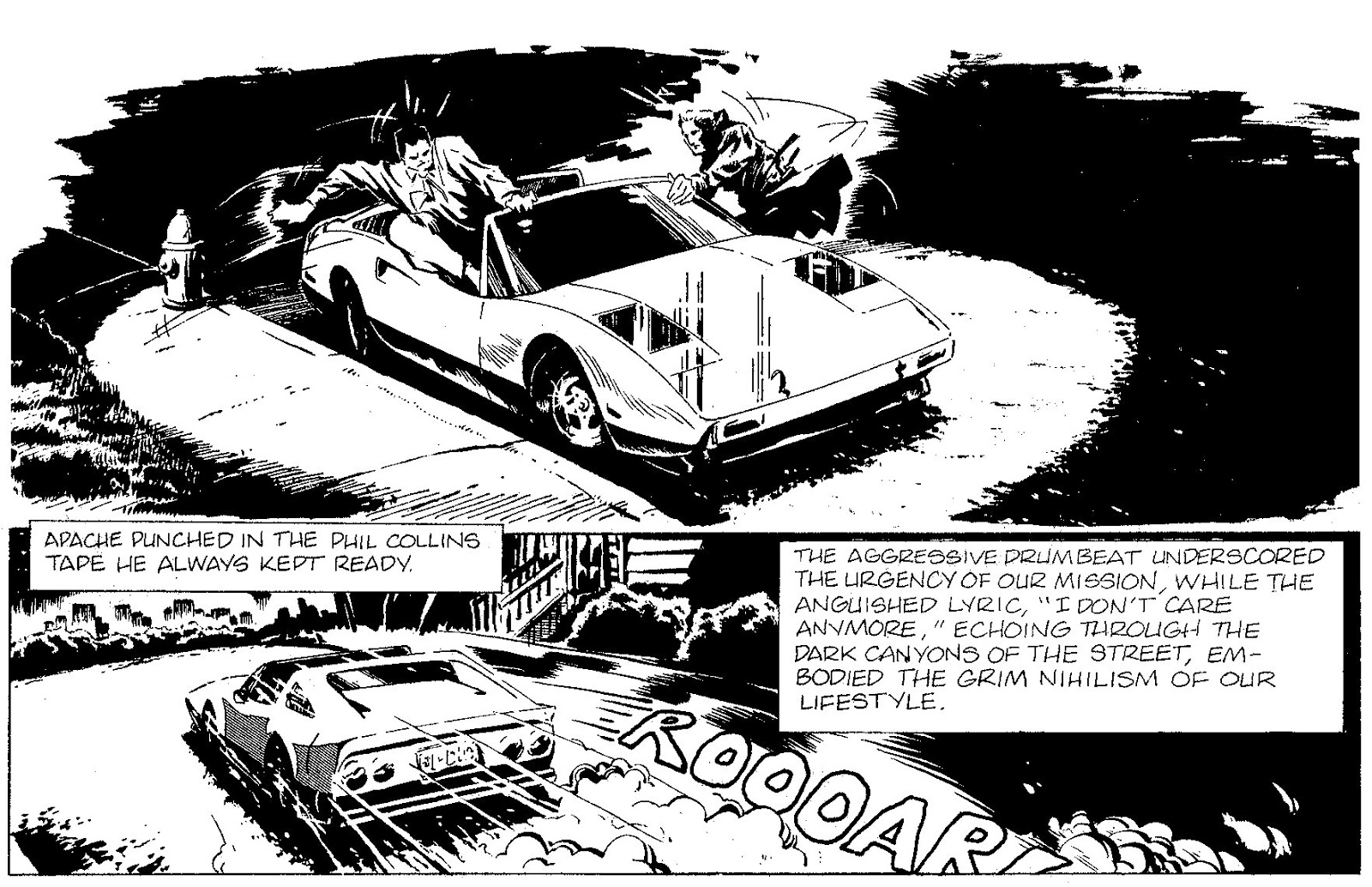
Some of those aspirations were apparently sufficiently advanced in 2002 as to justify this being published as a science-fiction, but most of the technology fetishised herein has since become commonplace, leaving the novel as a weird kind of period piece in which everyone still smokes in the pub. It sort of strains towards William Gibson, but just doesn't quite have the language; and by the time our man jumps in his car and blasts out his tape of the Clash, I couldn't keep myself from thinking of Lester Girls and Apache Dick with their beloved Phil Collins album in Gerard Jones' The Trouble with Girls:
I'm vaguely aware of Paul McAuley having written some Doctor Who novella which was supposed to be good, and although I've read it, I can't even remember what it was called at the moment. More recently his short story Little Lost Robot so impressed me when it turned up in an issue of Interzone as to leave his name lodged in my head when I saw this in the buy it cheap before we pulp the lot sale from which I picked up Beyond the Beyond, Little Fuzzy and others; so what the fuck, I concluded. Why not?
There was some initial hesitation on my part because I recall enjoying Little Lost Robot almost in spite of how it was written, which seemed kind of shrill and screechy with a suggestion of someone trying far too hard. Whole Wide World is similarly shrill and screechy but I realise this is simply how McAuley writes and it actually works once you get used to it, particularly in the context of a hard-boiled cop thriller such as what this is. Part of the screechiness manifests here as pop culture references specific to my generation, and the title itself is of course taken from Wreckless Eric. I have reservations about this sort of deal, just as all those New Adventures with chapters named after songs by the fucking Cure or the Smiths used to irritate the living shit out of me, even if the books themselves were decent, as they sometimes were. It's probably not the fault of the author, but I think it annoys me in apart because it's the sort of thing I used to do before I learned how to write - chuck in a few references to your fave band so everyone knows how cool you are and hopefully nobody will notice that you can't write; plus I'm still horrified by the continued existence of terminally beige Doctor Who authors of a certain vintage whose work these days mainly comprises hanging around on bulletin boards having opinions and making joking references to having once been a contender. If you're not sure what I mean here, just find some Who themed forum and look for threads debating which was the greatest Style Council album.
Anyway, it's irritating but McAuley just about gets away with it because the rest is so engaging as for you not to notice. Although that said, the novel is not without its problems in other respects. Amongst these, the most pronounced is probably it being centred around the inevitably gruesome murder of a teenage girl who, for the purpose of the plot, may as well be a prostitute. The video of her murder is all over the internet so as to make a number of somewhat blunt points about voyeurism, freedom of information, and so on; but the choice of victim tends to align the work with a thousand other lazily-drawn dramas in which we don't have to worry too much about the pivotal bucket of bloody innards because it was only a prostitute and was therefore probably complicit in its own murder by some means. So at heart, Whole Wide World may as well be Lynda La Plante with aspirations.
Some of those aspirations were apparently sufficiently advanced in 2002 as to justify this being published as a science-fiction, but most of the technology fetishised herein has since become commonplace, leaving the novel as a weird kind of period piece in which everyone still smokes in the pub. It sort of strains towards William Gibson, but just doesn't quite have the language; and by the time our man jumps in his car and blasts out his tape of the Clash, I couldn't keep myself from thinking of Lester Girls and Apache Dick with their beloved Phil Collins album in Gerard Jones' The Trouble with Girls:
Whole Wide World isn't bad of it's type, and is quite possibly above average of its type, so I wasn't bored, just occasionally disappointed. This is mainly because it isn't really about anything. It just sort of points at a stack of porn and a CCTV camera whilst pulling a knowing face, and that's your lot. Need I say more?
Yes, because you didn't actually finish the sentence, Paul.
Paul McAuley can obviously write. I just think he could afford to be a bit more ambitious than he is here, and a bit less like he's aiming for the airport book stand.
Wednesday, 25 November 2015
Beyond the Beyond
Poul Anderson Beyond the Beyond (1969)
Darn it! I thought I had Poul Anderson more or less figured out - perhaps not the greatest writer of all time but at least more or less reliable, a guy who could pull together a functioning sentence and usually toss something interesting in the general direction of his readers. I can tell why The Queen of Air and Darkness won a Hugo, and the rest of the stories that came in the collection of the same name were decent, as were the novels World Without Stars and The High Crusade, and although Genesis was kind of dull, they can't all be Johnny Cash at Folsom Prison; but this...
Beyond the Beyond collects six short stories written between 1954 and 1967, specifically six fairly long short stories which really could have stood to be a lot shorter. Working on the assumption that it isn't simply me reaching my science-fiction saturation point, the problem may not even be the length of these efforts. It's quite difficult to really pin it down to any one thing, or unfortunately even to care that much. Some of the ideas are natty enough, and so the likes of Memory and er... one of the others but I can't even remember which one and flicking through the book rings no bells - they at least seem to have potential; and yet still I was bored throughout, a little flurry of intrigue at the beginning of each tale settling into an undifferentiated route march through the rest, struggling to remember who was who, what was happening, and why any of it should matter. The closest I can come to an analysis of the problem is too little detail at the beginning of each story, giving us only sketchy impressions of setting, character, and purpose, with this deficit further unbalanced by great lumps of exposition, material which really should have stayed in the outline, why the Quanions of Zargo should have such strong feelings about their trade embargo against the Zobulan Bongo-men, and so on, stuff about which no reader should really be required to give a shit.
On the other hand, this only seems to apply to some of the stories here, so I'm not exactly sure why they should all blend into an anonymously droning whole. Anderson's libertarian politics seem to be of the mostly humanitarian rather than toxic variety, and in any case don't seem to intrude on his storytelling, unless it occurred during one of the passages where I was thinking about something else. The Sensitive Man can probably be safely categorised as pure arseache, it being a van Vogt style superhuman spy thriller without any of the weirdness which makes van Vogt readable, and additionally burdened with the sort of ham-fisted sexism which makes it impossible to read without visualising the main characters as Harry Enfield and Paul Whitehouse.
Darn it! I thought I had Poul Anderson more or less figured out - perhaps not the greatest writer of all time but at least more or less reliable, a guy who could pull together a functioning sentence and usually toss something interesting in the general direction of his readers. I can tell why The Queen of Air and Darkness won a Hugo, and the rest of the stories that came in the collection of the same name were decent, as were the novels World Without Stars and The High Crusade, and although Genesis was kind of dull, they can't all be Johnny Cash at Folsom Prison; but this...
Beyond the Beyond collects six short stories written between 1954 and 1967, specifically six fairly long short stories which really could have stood to be a lot shorter. Working on the assumption that it isn't simply me reaching my science-fiction saturation point, the problem may not even be the length of these efforts. It's quite difficult to really pin it down to any one thing, or unfortunately even to care that much. Some of the ideas are natty enough, and so the likes of Memory and er... one of the others but I can't even remember which one and flicking through the book rings no bells - they at least seem to have potential; and yet still I was bored throughout, a little flurry of intrigue at the beginning of each tale settling into an undifferentiated route march through the rest, struggling to remember who was who, what was happening, and why any of it should matter. The closest I can come to an analysis of the problem is too little detail at the beginning of each story, giving us only sketchy impressions of setting, character, and purpose, with this deficit further unbalanced by great lumps of exposition, material which really should have stayed in the outline, why the Quanions of Zargo should have such strong feelings about their trade embargo against the Zobulan Bongo-men, and so on, stuff about which no reader should really be required to give a shit.
On the other hand, this only seems to apply to some of the stories here, so I'm not exactly sure why they should all blend into an anonymously droning whole. Anderson's libertarian politics seem to be of the mostly humanitarian rather than toxic variety, and in any case don't seem to intrude on his storytelling, unless it occurred during one of the passages where I was thinking about something else. The Sensitive Man can probably be safely categorised as pure arseache, it being a van Vogt style superhuman spy thriller without any of the weirdness which makes van Vogt readable, and additionally burdened with the sort of ham-fisted sexism which makes it impossible to read without visualising the main characters as Harry Enfield and Paul Whitehouse.
With those tilted gray eyes, that delicately curved nose and a wide sullen mouth, she could have been a beauty had she wanted to be.
One of the modern type, thought Dalgetty. A flesh-and-blood machine, trying to outmale men, frustrated and unhappy without knowing it, and all the more bitter for that.
Obviously a lezzer. Don't worry yourself about it, mate.
Even this sort of thing doesn't really occur with enough force or frequency to spoil the whole, so I'm at a loss. I know even the best writers have a few duds, but Beyond the Beyond really feels like the publisher had already printed all of the good stuff and was left with just these. I managed to read right through to the last page, which I suppose must be something, but I can't say that it was fun.
Tuesday, 9 September 2014
The High Crusade
Poul Anderson The High Crusade (1960)
The universe has been chucking Poul Anderson at me with some frequency of late, a trend which reached its peak when the writer turned up as a character in a short story by Philip K. Dick, and then The High Crusade was mentioned somewhere online in relation to Philip Purser-Hallard's The Pendragon Protocol - a more recent example of science-fiction with knights in armour - although I can't recall whether it was Andrew Hickey or Philip himself who made the reference. Anyway, the point is that I'd never before heard of The High Crusade, so when I noticed it sat perkily upon the shelf of a second hand book store I hadn't quite intended to enter, it seemed like the decision had already been made on my behalf; besides which, excepting the later and somewhat disappointing Genesis, I have the idea that I generally enjoy Poul Anderson's writing and I'm not sure why I haven't read more of it.
The High Crusade is probably intended for a younger audience, given the ludicrous premise and generally wholesome turn of phrase, but that isn't a problem. Blue skinned invaders land their spacecraft in mediaeval England, only to have said craft appropriated by the entire population of the local village who then go off to have adventures in space, as eventually recounted by the local monk in one of those illuminated manuscripts. Apparently they were itching to go off on the crusades just as the alien craft turned up, and this seemed like the next best thing...
It's hokey and is written in a sort of clean-cut American approximation of old English - two parts Marvel Shakespearian to one part Disney's Camelot, and regular protestations of the world actually being flat serve to remind us that these people will one day turn up in the crowd scenes of Black Adder, although I seem to recall the supposed mediaeval belief in a flat Earth being mostly bollocks. Inevitably, given the premise of the story - not least its underlying imperialism - there's a lot of this which doesn't really work if you think about it too hard, or even at all; but sufficient liberal concessions are nevertheless made so as to avoid anything too unsavoury, and our knights regard of the races they encounter can probably be justified as genuine Christian compassion - as distinct from the sort of Christian compassion which extends no further than one's own kind which one might reasonably expect of our heroes, given their cultural heritage. It also helps that Anderson writes with an understated wit which does its job without digging you in the ribs and winking every two minutes as Douglas Adams tended to:
Sir Roger himself conferred with two other emissaries. These were the representatives of the other starfaring nations, Ashenkoghli and Pr?*tans. The odd letters in the latter name are my own, standing respectively for a whistle and a grunt. I will let one such conversation stand for the many that took place.
As usual, it was in the Wersgor language. I had more trouble interpreting than I was wont, since Pr?*tan was in a box which maintained the heat and poisonous air he needed, and talked through a loudspeaker with an accent worse than my own. I never even tried to know his personal name or rank, for these involved concepts more subtle to the human mind than the books of Maimonides. I thought of him as Tertiary Eggmaster of the Northwest Hive, and privately I named him Ethelbert.
The High Crusade falls a long way short of being the greatest science-fiction novel ever written, and truthfully Anderson probably could have done better with the basic concepts, but it's short and relatively sweet with enough going on to keep it interesting, and is as such hard to fault.
Monday, 18 August 2014
Minority Report
Philip K. Dick Minority Report (1987)
Moving onto the fourth collection of Dick's short stories, this one fares a little better than its predecessor. It may be significant that this assemblage brings together stories written over a period of nine years, as opposed to hammered out during a couple of afternoons as was the case with at least one of the earlier volumes; although the suggestion of a more leisurely pace may be misleading, as there's actually a five year gap somewhere in the middle here during which he was presumably churning out novels, fixing television sets, getting divorced and so on. Almost certainly of greater significance is Dick's return to short form in 1963 after a long break and, more crucially, immediately following the experience of a giant metal face staring down at him from the sky. Whilst a huge slit-eyed and morally ambiguous God checking him out for the best part of a week may doubtless have been somewhat unnerving, the vision apparently did wonders for Phil's writing if this lot are anything to go by.
This collection is already off to a good start with Autofac and at least enough solid gold Dick classics to qualify the whole as effectively a greatest hits - The Mold of Yancy, The Unreconstructed M, and War Game being at least as good as any of his novels even without their eventually being woven into The Penultimate Truth and others. Things begin to get really weird with the post-giant metal face stories as Dick's sense of humour comes to the fore, whether through the Swiftian satire of If There Were No Benny Cemoli or the raging absurdity of Novelty Act and the Jim Briskin stories; and we almost go right over the postmodern edge with the peculiarly self-referential Orpheus With Clay Feet and Waterspider, the hero of which is Dick's fellow author, Poul Anderson; and whilst we're here, I also found it slightly irresistable that A.E. van Vogt should be referenced by name in these last two stories.
Minority Report is an impressive and satisfying collection, which comes as a relief after the relatively underwhelming third volume. It's also interesting that Minority Report, probably the best known of this lot thanks to the film, is one of the few that doesn't really do much.
Monday, 20 August 2012
The Outer Reaches
August Derleth (editor) The Outer Reaches (1951)
It feels like an age since I picked up one of these satisfaction-pretty-much-guaranteed vintage collections, possibly because whilst it seems like every other English charity shop has a box of these things stashed away somewhere, their like has proven more elusive here in the States. Therefore I'm re-reading The Outer Reaches, presented to me along with Derleth's Beachheads in Space some years ago by Glenn Wallis who told me here, you might be able to get some ideas from these; these collections represented the inaugural dip of my symbolic toe into the golden age bath tub, the first stories I read out of sheer curiosity without prior knowledge of their authors, my first voyage out beyond the orbit of Philip K. Dick to the older worlds of Astounding Science-Fiction, Amazing Stories, and so on. August Derleth had been chums with H.P. Lovecraft, I reasoned, so that seemed like a recommendation.
The stories collected in The Outer Reaches represent the personal favourite of each author from amongst his own body of work, at least as of 1951. Whilst, in this respect, there's a couple of slightly puzzling submissions - notably Leon Sprague de Camp's Git Along!, an oddly disappointing effort from a generally solid author; and David H. Keller's Service First which had me wondering whether his might be another of John Wyndham's myriad pseudonames, it being so close in tone to the dreaded Pawley's Peepholes; but, these aside, it's a predictably satisfying collection with cracking stuff from Poul Anderson, Nelson Bond, Ray Bradbury and others. With the past being something of a foreign country, the appeal of short stories of this form must surely increase as years go by, and so I'm inclined to dispute the general accusation of it being less than great literature. This was shamelessly populist science-fiction written without anything like the number of unspoken literary rules of today: stupid, wacky, and mostly wonderful.
Considering how much of this stuff I've read since Glenn first sent this book my way, it's probably fair to say that The Outer Reaches did indeed give me some ideas.
It feels like an age since I picked up one of these satisfaction-pretty-much-guaranteed vintage collections, possibly because whilst it seems like every other English charity shop has a box of these things stashed away somewhere, their like has proven more elusive here in the States. Therefore I'm re-reading The Outer Reaches, presented to me along with Derleth's Beachheads in Space some years ago by Glenn Wallis who told me here, you might be able to get some ideas from these; these collections represented the inaugural dip of my symbolic toe into the golden age bath tub, the first stories I read out of sheer curiosity without prior knowledge of their authors, my first voyage out beyond the orbit of Philip K. Dick to the older worlds of Astounding Science-Fiction, Amazing Stories, and so on. August Derleth had been chums with H.P. Lovecraft, I reasoned, so that seemed like a recommendation.
The stories collected in The Outer Reaches represent the personal favourite of each author from amongst his own body of work, at least as of 1951. Whilst, in this respect, there's a couple of slightly puzzling submissions - notably Leon Sprague de Camp's Git Along!, an oddly disappointing effort from a generally solid author; and David H. Keller's Service First which had me wondering whether his might be another of John Wyndham's myriad pseudonames, it being so close in tone to the dreaded Pawley's Peepholes; but, these aside, it's a predictably satisfying collection with cracking stuff from Poul Anderson, Nelson Bond, Ray Bradbury and others. With the past being something of a foreign country, the appeal of short stories of this form must surely increase as years go by, and so I'm inclined to dispute the general accusation of it being less than great literature. This was shamelessly populist science-fiction written without anything like the number of unspoken literary rules of today: stupid, wacky, and mostly wonderful.
Considering how much of this stuff I've read since Glenn first sent this book my way, it's probably fair to say that The Outer Reaches did indeed give me some ideas.
Subscribe to:
Posts (Atom)