Tuesday, 15 December 2015

Whole Wide World


Paul McAuley Whole Wide World (2002)
I'm vaguely aware of Paul McAuley having written some Doctor Who novella which was supposed to be good, and although I've read it, I can't even remember what it was called at the moment. More recently his short story Little Lost Robot so impressed me when it turned up in an issue of Interzone as to leave his name lodged in my head when I saw this in the buy it cheap before we pulp the lot sale from which I picked up Beyond the Beyond, Little Fuzzy and others; so what the fuck, I concluded. Why not?

There was some initial hesitation on my part because I recall enjoying Little Lost Robot almost in spite of how it was written, which seemed kind of shrill and screechy with a suggestion of someone trying far too hard. Whole Wide World is similarly shrill and screechy but I realise this is simply how McAuley writes and it actually works once you get used to it, particularly in the context of a hard-boiled cop thriller such as what this is. Part of the screechiness manifests here as pop culture references specific to my generation, and the title itself is of course taken from Wreckless Eric. I have reservations about this sort of deal, just as all those New Adventures with chapters named after songs by the fucking Cure or the Smiths used to irritate the living shit out of me, even if the books themselves were decent, as they sometimes were. It's probably not the fault of the author, but I think it annoys me in apart because it's the sort of thing I used to do before I learned how to write - chuck in a few references to your fave band so everyone knows how cool you are and hopefully nobody will notice that you can't write; plus I'm still horrified by the continued existence of terminally beige Doctor Who authors of a certain vintage whose work these days mainly comprises hanging around on bulletin boards having opinions and making joking references to having once been a contender. If you're not sure what I mean here, just find some Who themed forum and look for threads debating which was the greatest Style Council album.

Anyway, it's irritating but McAuley just about gets away with it because the rest is so engaging as for you not to notice. Although that said, the novel is not without its problems in other respects. Amongst these, the most pronounced is probably it being centred around the inevitably gruesome murder of a teenage girl who, for the purpose of the plot, may as well be a prostitute. The video of her murder is all over the internet so as to make a number of somewhat blunt points about voyeurism, freedom of information, and so on; but the choice of victim tends to align the work with a thousand other lazily-drawn dramas in which we don't have to worry too much about the pivotal bucket of bloody innards because it was only a prostitute and was therefore probably complicit in its own murder by some means. So at heart, Whole Wide World may as well be Lynda La Plante with aspirations.

Some of those aspirations were apparently sufficiently advanced in 2002 as to justify this being published as a science-fiction, but most of the technology fetishised herein has since become commonplace, leaving the novel as a weird kind of period piece in which everyone still smokes in the pub. It sort of strains towards William Gibson, but just doesn't quite have the language; and by the time our man jumps in his car and blasts out his tape of the Clash, I couldn't keep myself from thinking of Lester Girls and Apache Dick with their beloved Phil Collins album in Gerard Jones' The Trouble with Girls:
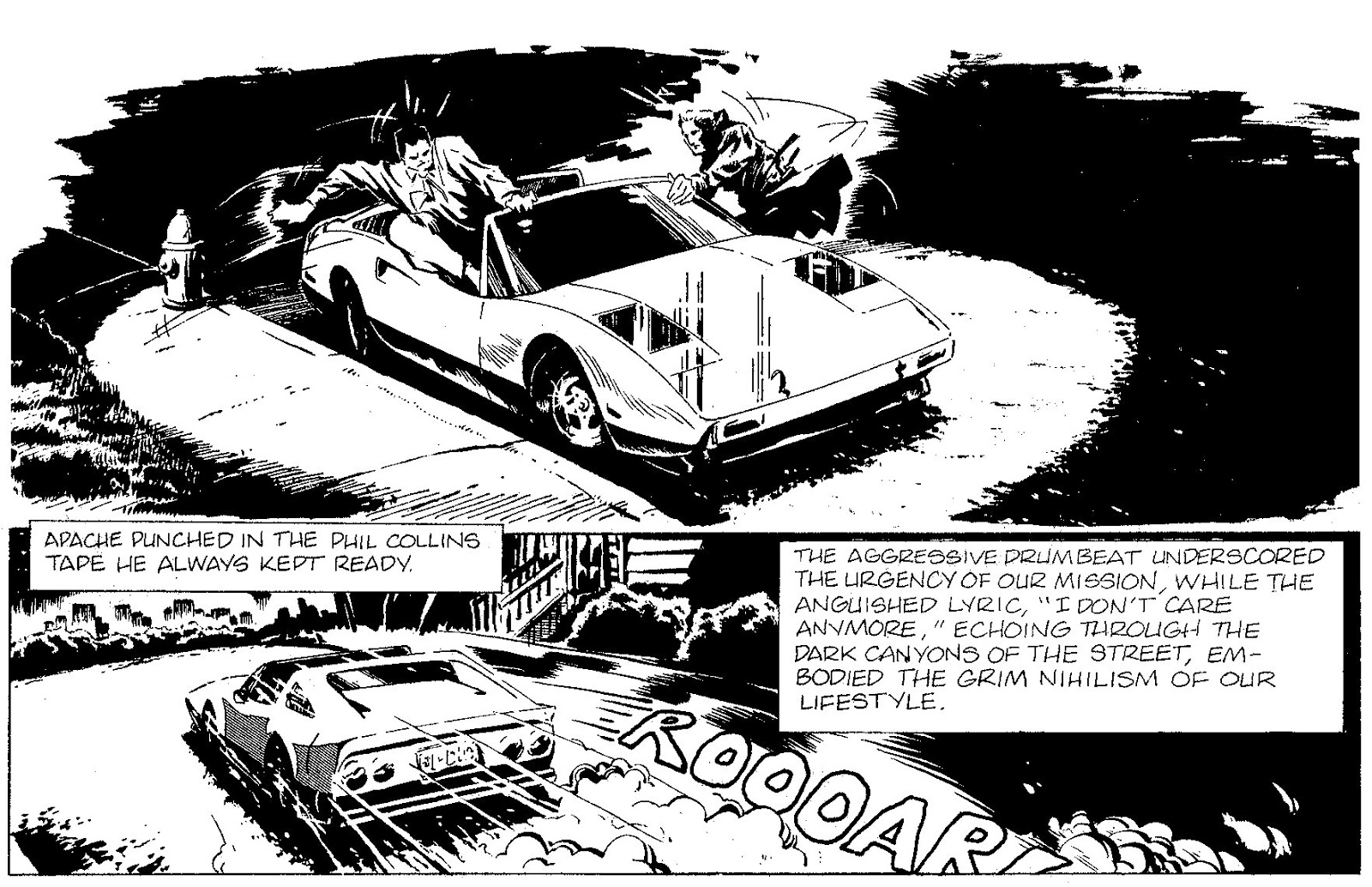


Whole Wide World isn't bad of it's type, and is quite possibly above average of its type, so I wasn't bored, just occasionally disappointed. This is mainly because it isn't really about anything. It just sort of points at a stack of porn and a CCTV camera whilst pulling a knowing face, and that's your lot. Need I say more?

Yes, because you didn't actually finish the sentence, Paul.

Paul McAuley can obviously write. I just think he could afford to be a bit more ambitious than he is here, and a bit less like he's aiming for the airport book stand.

Wednesday, 9 December 2015

Trouble With Lichen


John Wyndham Trouble With Lichen (1960)
George Formby was concerned about his prize-winning marrow, specifically that it might once again mysteriously go missing the evening before the competition at the church hall and thus fail to win its due prize. He sat by the shed on his allotment with one beady eye fixed securely upon the treasured vegetable, determined to avoid a repeat of last year's shambolic episode in which not only had he failed to deliver the lovingly nurtured and cultivated winning marrow, but the cup had gone to Will Hay for a marrow of suspiciously similar volume and appearance, a marrow which had apparently sprouted during the night on an allotment entirely given over to carrots and turnips. That Will Hay was a shifty one.

George's thoughts were derailed as he heard a sound behind him, the tramp of a wellington boot at the side of his shed, a wellingon boot planted softly on the path - so softly as to suggest that its wearer might prefer to pass undetected.

'Oh - so that's your game, is it?' George chirped, leaping angrily to his feet. He hefted his spade with both hands and swung it directly into the face of the intruder. The blade sprang back chiming like a gong. George pulled himself up to his full height, ready to box the miscreant's ears.

'Ugh,' groaned the floored itinerant, head still vibrating as though he were a character in one of those Mickey Mouse cartoons you see at the pictures. 'Where am I?'

'You're not Will Hay!' George shrieked as the realisation dawned. His eyes popped from his head and his Adam's apple bobbed up and down with rising tumult. 'Oh mother!'

'Who am I?' croaked John Wyndham the popular science-fiction author, and that evening, despite a splitting headache, he sat down at his typewriter and got started on Trouble With Lichen.

That's my theory anyway. I probably should have been forewarned by my mother borrowing this book to read it just as I bought it back from the Oxfam shop, and then reading it with a fairly serious frown for most of that afternoon.

The premise is that a form of lichen is discovered to contain a compound which greatly extends the span of human life. One might see considerable potential in such a story, not least because it's John Wyndham at the wheel, and as we know, John Wyndham was more than capable of spinning a top quality yarn. Unfortunately what he has written here settles into a two-hundred page conversation about marketing once we've got the interesting bit out of the way. It's so heavy with exposition that I'm inclined to wonder whether it might not have been an aborted script for film or television, one which Wyndham perhaps abandoned upon noticing that someone had already made The Man in the White Suit. I actually read up to the last fifty pages and then skipped ahead, every tenth page, just to confirm that the rest was more of the same, as indeed it was. I was that bored.

It isn't quite the cosy catastrophe which Brian Aldiss famously characterises as representing the worst of Wyndham - its tone is as ever informed by Wyndham's class and culture, although there's very little which can be described as twee; but it fails as the satire it's plainly supposed to be because it's just not amusing. In fact, aside from dubious parodies of news items from left-leaning newspapers - all spun from the side-splitting notions of socialist governments nationalising everything and how men who work in factories are mainly interested in titties and beer - it's difficult to tell quite where the satire occurs. Given the emphasis on gossip, rambling conversation, and the cosmetics industry - and of course the proliferation of female characters - I have a horrible feeling that Wyndham may have regarded this book as one for the ladies, and that Trouble With Lichen is this is what a feminist looks like if you happen to be a pipe-smoking home counties chap enjoying a glass of Sherry up at the manor whilst wearing a tweed hunting jacket. I've a hunch this may also explain the occasional references to suffragettes.


'All my life I've been watching potentially brilliant women let their brains, and their talents, rot away. I could weep for the waste of it; for what they might have been, and might have done... But give them two hundred, three hundred years, and they'll either have to employ those talents to keep themselves sane - or commit suicide out of boredom.'

Jolly good show! Given a couple of hundred years, even the lowliest housewife might learn to think a little more like a chap!

I suppose it's the thought that counts, but it still makes for an extraordinarily dull read. Given Wyndham's record, he's probably allowed a few stinkers, but even the dreaded Pawley's Peepholes isn't quite this awful. More than anything, Trouble With Lichen reads like some droning self-published effort.

Tuesday, 8 December 2015

Helliconia Spring


Brian Aldiss Helliconia Spring (1982)
I hadn't really planned to read the Helliconia trilogy despite its admittedly intriguing premise, partially because the thing looked enormous and I tend to prefer shorter works, and partially because it's Brian Aldiss. Of the man's novels, those I've thus far read have all been excellent, even exceptional, but his short stories are so bad as to have somewhat soured my view of the man, or at least to sour my view just enough as to inspire a certain reluctance when it comes to further toes dipped into the authorial pool, so to speak; but Mrs. Pamphlets and I were at some clearancey warehouse thing, and every book was to be sold off at just twenty-five cents a pop, and there were the other two - Helliconia Summer and Helliconia Winter, due to be pulped if no-one bought them. Naturally I couldn't just leave them to their fate, and so then I had to hunt down Helliconia Spring because obviously I'm not going to read just the second and third part.

The aforementioned intriguing premise is of Helliconia being a world taking several thousand years to orbit its sun - or at least its principal sun - with seasons lasting about six-hundred years. This is, I suppose, partially why I thought fuck it and decided to read the thing: Aldiss gives good environment, it being more or less the main focus of those novels of his which I've read - Hothouse, Non-Stop, and the superb novella length Total Environment; and even the narratives of Earthworks and Frankenstein Unbound are determined to a significant extent by their settings. He does it again here with a developing civilisation repeatedly thrown back into its own stone age by the dramatic cycle of climate, forming a social history with the memory of an admittedly long-lived goldfish. Particularly satisfying is how Aldiss has really pulled out the stops with this one, which I guess is why it needed to be a trilogy. The main character is the history of the people of Helliconia, and here we focus on the subterranean dwelling remnants of what may have been some previous civilisation as they emerge from the ground to build themselves a new stone age as the snow retreats - for the first time so far as anyone can tell, except obviously it isn't. We experience the rebirth of mythology, science, and politics as illustrated through rudimentary society with the kind of focus which reminds me of the first few episodes of Kenneth Clarke's Civilisation television series, at least more so than it reminds me of any other novel I've read. Accordingly it's the big picture which matters, meaning - oddly - that, the details are not always of such consequence as they might be, and that the characters aren't so significant as the patterns formed by their lives. Keeping track of unfamiliar names is therefore not such an issue as it would be had Aldiss written with more obviously dynastic intent. This means that what might under other circumstances constitute a slog makes for an improbably breezy read given its page count and tendency to shuffle rather than run.

Ultimately the point of the book is revealed as being about nothing less than history itself and the vital importance of our being able to comprehend it fully.
'Do you understand that? Understanding is harder than slitting throats, isn't it? To comprehend fully what I tell you, you must first understand and then grasp the understanding with your imagination, so that the facts live. Our year is four-hundred and eighty days long, that we know. That is the time we take on Hrl-Ichor to make a complete circle about Batalix. But there is another circle to be made, the circle of Batalix and our world about Freyr. Are you prepared to hear the word? It takes eighteen-hundred and twenty-five small years... Imagine that great year! ...Until our day, few could imagine it! For each of us can expect only forty years of life. It would take forty-six of our lifetimes to add up to one whole circle of this world about Freyr. Many of our lives find no echo, yet are part of that greater thing. That is why such knowledge is difficult to grasp and easy to lose in time of trouble.'

In terms of our own political situation, this seems particular relevant now given the rise to power of a deafeningly vocal minority who apparently need the invention of the wheel explaining to them all over again. I have no idea how Helliconia will continue, but it starts well, is beautifully constructed and written, and is greatly more profound than may be obvious at first glance.

Wednesday, 25 November 2015

Beyond the Beyond


Poul Anderson Beyond the Beyond (1969)
Darn it! I thought I had Poul Anderson more or less figured out - perhaps not the greatest writer of all time but at least more or less reliable, a guy who could pull together a functioning sentence and usually toss something interesting in the general direction of his readers. I can tell why The Queen of Air and Darkness won a Hugo, and the rest of the stories that came in the collection of the same name were decent, as were the novels World Without Stars and The High Crusade, and although Genesis was kind of dull, they can't all be Johnny Cash at Folsom Prison; but this...

Beyond the Beyond collects six short stories written between 1954 and 1967, specifically six fairly long short stories which really could have stood to be a lot shorter. Working on the assumption that it isn't simply me reaching my science-fiction saturation point, the problem may not even be the length of these efforts. It's quite difficult to really pin it down to any one thing, or unfortunately even to care that much. Some of the ideas are natty enough, and so the likes of Memory and er... one of the others but I can't even remember which one and flicking through the book rings no bells - they at least seem to have potential; and yet still I was bored throughout, a little flurry of intrigue at the beginning of each tale settling into an undifferentiated route march through the rest, struggling to remember who was who, what was happening, and why any of it should matter. The closest I can come to an analysis of the problem is too little detail at the beginning of each story, giving us only sketchy impressions of setting, character, and purpose, with this deficit further unbalanced by great lumps of exposition, material which really should have stayed in the outline, why the Quanions of Zargo should have such strong feelings about their trade embargo against the Zobulan Bongo-men, and so on, stuff about which no reader should really be required to give a shit.

On the other hand, this only seems to apply to some of the stories here, so I'm not exactly sure why they should all blend into an anonymously droning whole. Anderson's libertarian politics seem to be of the mostly humanitarian rather than toxic variety, and in any case don't seem to intrude on his storytelling, unless it occurred during one of the passages where I was thinking about something else. The Sensitive Man can probably be safely categorised as pure arseache, it being a van Vogt style superhuman spy thriller without any of the weirdness which makes van Vogt readable, and additionally burdened with the sort of ham-fisted sexism which makes it impossible to read without visualising the main characters as Harry Enfield and Paul Whitehouse.

With those tilted gray eyes, that delicately curved nose and a wide sullen mouth, she could have been a beauty had she wanted to be.

One of the modern type, thought Dalgetty. A flesh-and-blood machine, trying to outmale men, frustrated and unhappy without knowing it, and all the more bitter for that.

Obviously a lezzer. Don't worry yourself about it, mate.

Even this sort of thing doesn't really occur with enough force or frequency to spoil the whole, so I'm at a loss. I know even the best writers have a few duds, but Beyond the Beyond really feels like the publisher had already printed all of the good stuff and was left with just these. I managed to read right through to the last page, which I suppose must be something, but I can't say that it was fun.

Tuesday, 24 November 2015

Walking to Hollywood


Will Self Walking to Hollywood (2010)
Returning for what seems like the umpteenth time to the subject of fiction spilling over into real life, as it did with both 1985 and The Cornelius Chronicles to one degree or another, here's Walking to Hollywood, which I hadn't even heard of prior to stumbling across it in the book store. Perhaps my curiosity summoned it into existence.

Having Ralph Steadman design the cover was clearly no arbitrary choice, it being an acknowledgement of the kinship between this and Hunter S. Thompson's Fear and Loathing in Las Vegas, as illustrated by Steadman. I never actually made it through Fear and Loathing in Las Vegas, which I understand to be essentially autobiographical filtered through dangerous quantities of hard drugs with a whole lot of fibbing tossed in where appropriate. That said, I very much enjoyed The Curse of Lono, also by Hunter S. Thompson and Ralph Steadman, and Walking to Hollywood is in the same tradition.

It's autobiographical in so much as Will Self loves walking, and this is a book about walking, and I'm pretty sure this is a true story, literally for most of its page count and figuratively for the rest; and it's autobiographical in so much as the main character is an author by the name of Will Self, and an author who believes that the best way to understand territory is to walk it, so that's what he does.

Walking to Hollywood divides into three short stories, three main walks unified by a number of themes in such a way as to feel very much part of a whole without the reader, or at least this reader, being quite sure why. The first part deals with Self's fixation with scale as personified by a dwarf of his presumably imaginary acquaintance - an artist who fills the world with elephantine representations of his own image - although this is a fixation I'm not sure I'd
ever actually noticed. The projection of a larger than life image informs the walk to Hollywood, undertaken as a quest to discover who or what killed the film industry - killed meaning turned all to shit in this case; and this section becomes increasingly weird, being written as the film of the book of the film with Self alternately trying to work out whether he's played by David Thewlis or Pete Postlethwaite, finding himself turned away by the Church of Scientology, and then teaming up with Scooby Doo.

The perplexing thing was that during the hundred-year hegemony of the movie everything had been filmed - including films themselves. Actors had played historical personages, and those personages had also played themselves, while the actors that had played them appeared in other movies - playing themselves. This poly-dimensional cat's cradle of references had snared plenty of people with reality-testing abilities far better than my own, and I maintained a certain amused tolerance for the way I lost myself in fugal ruminations...

I'm not sure we really discover just who killed the art of film in the end, although there are some great arguments thrown up in the process of investigation, plenty of engagingly hallucinogenic surrealism, and an immensely satisfying demolition of Mike Myers. If anyone was waiting for a Faction Hollywood novel, then this is probably it.

The final section follows Self walking a crumbling coastal path in northern England, a route which is
gradually being reclaimed by the sea. Whilst all sorts of themes associate this final walk with its predecessors, I found it difficult to really settle on any one theme as being of greatest or even particular significance; and this is maybe the point, namely that the individual needs to walk the territory in order to achieve a true understanding. Second hand testimony, whether the Hollywood version starring David Thewlis as Will Self or just me trying to describe this stuff to whoever may be reading, is never entirely reliable. So whilst the first two parts dissect territories, both physical and psychological, possibly the conclusion may dissect the very fact of there even being territory to discuss, represented as the path, homes, and even villages gradually dissolving into the sea.

I can't even tell whether what I've written here amounts to anything coherent in relation to the book, or whether it's all bollocks, just a chain of vague ideas which seem related and can be nicely strung together like one of those child's games with the plastic monkeys. The important thing to take away from this is that Walking to Hollywood is pretty damned incredible, possibly even Self's best.

Wednesday, 18 November 2015

1985


Mark Millar & Tommy Lee Edwards 1985 (2009)
Attending a comic book convention in North Carolina necessitated a couple of nights in an unusually uncomfortable hotel bed in a room shared with our kid - who apparently requires only two hours sleep - which made it difficult to concentrate on my current bedtime reading, Will Self's Walking to Hollywood, prompting an excursion into something less demanding, namely 1985 which I picked up at the aforementioned convention. This volume collects another title I missed at the time due to being somewhat out of the loop with monthly comics, and yet another story to blur the distinction between fiction and reality. What with Will Self and Michael Moorcock, I seem to have encountered a lot of this breaking of the fourth wall of late without it being something consciously sought out on my part, so it's tempting to wonder whether the universe might be trying to tell me something.

Admittedly 1985 is slightly different in that the fourth wall is broken for the characters of this book whilst their own fourth wall remains more or less intact, which as such prevents it from becoming a variation on Grant Morrison. 1985 is set in a world recognisable as our own but for the sudden and unexpected revelation of 1980s Marvel comics villains turning out to be real. As an exercise in nostalgia this seems initially strange to me given that I haven't had much experience of Marvel since most of the characters invoked here were still in service, so I wasn't really aware of the Shocker, MODOK, or the Stilt Man having passed into comics history, presumably having been replaced with the blood-drenched, katana-weilding assassins of Rob Liefeld vintage; and it was additionally weird reading 1985 in a hotel room above a convention centre packed with comic fans dressed as superheroes, and dressed as highly convincing superheroes. There was one guy who I'm pretty certain was actually the real Captain America, not just some impersonator.


Anyway, 1985 is set right here, and our protagonist is a young comic-obsessive kid who recognises the monsters emerging from the house in the woods because he's read about them in back issues of Spiderman, Iron Man, Avengers and so on. Unlike Grant Morrison's somewhat ponderous Joe the Barbarian, there's no real attempt to rationalise any of this, at least not by real world terms because that isn't really the point, and nor is it grittily realistic superheroes having to go to the bog and pay child support. The point, perhaps peculiarly, seems to be a reminder of the initial excitement at least some of us once had reading comics as kids, before anyone found it necessary to point out that Batman was almost certainly some sort of rubber fetishist. Accordingly the story is told with the determined earthy realism of a Harvey Pekar monologue, underscored by the beautiful, almost photorealist art of Tommy Lee Edwards, then contrasted with the absolutely deadpan intrusion of characters from old comics; and although by rights they should appear absurd, there is no doubt of their being monsters in every sense.

There he was, standing in front of me: A comic book character as real and as awesome as Mount Rushmore or Ronald Reagan. But it's the smell I remember most. Nothing can prepare you for just how bad the Hulk smells.

Thus does it continue, comic book violence replaced by real horror in this, our version of reality, but with a lightness of touch you probably might not expect of Mark Millar, with the appearance of the otherwise ludicrous MODOK presenting a particularly nightmarish interlude.

1985 is nothing profound, although it has no ambition to be anything beyond what it is; but it's a moving and highly satisfying testimony to the art form, and to that which we once took from the art form before some sneering Android's Dungeon employee called us Marvel Zombies and asked had we never heard of Love & Rockets; because apparently you should always feel ashamed for enjoying cheap, populist entertainment. This point has struck me as worth making in so much as the Captain America and X-Men comics I read back in 1985 had a more lasting impression on me than any of the independent cinematic classics I saw that year at art college. Similarly, returning to the point that I read this whilst attending a comic book convention, I couldn't help but notice how all those kids in capes or with purple wigs and fake pointy ears weren't anything like so saaaaad as I had anticipated. On the contrary, it made me feel good to see just how many of them there were, and how much effort had been expended in pursuit of their impersonations, and how happy it clearly made them. In fact, there was nothing saaaaad about them at all. In may ways I felt inspired by their example, and that's sort of what 1985 is all about.

Tuesday, 17 November 2015

A Princess of Mars


Edgar Rice Burroughs A Princess of Mars (1912)
Whilst I appreciate the general concept of Edgar Rice Burroughs as an institution, I've had some trouble with his books, or at least with the two I've read. Both Tarzan of the Apes and Pirates of Venus seem reasonably well written but suffer from certain cultural details so resolutely of their time that I just couldn't get past the sound of my own wincing. A Princess of Mars, so I was told, was the one to go for, written before Burroughs' prose began to crumble under the pressure of curling off yet another sequel every three days; and against all odds, I enjoyed the recent film adaptation for what it's worth.

Just to get it out of the way, I suppose we should acknowledge that A Princess of Mars is roughly what has come to be known as pulp fiction, a term deriving - at least so far as I understand it - from the more populist magazines, the Astoundings and Amazings, having been used as pulp to pad out crates of more important stuff during the war - reet classy leather-bound editions of The Lord of the Rings for example, proper books which might be read by doctors or dentists. Whilst it's true that the tastes of the reading public tended to dictate the general kind of story which appeared in the Astoundings and Amazings, pulp as a vaguely pejorative term equating to gob-punching tales for thickies is misleading and generally akin to returning that Ramones album to the record store because you got it home and found it sounded nothing like Emerson, Lake and Palmer. Of course, some pulps were shite, but this is generally true of publishing regardless of whether it's the sort of thing one might find in the home of Margaret Attwood or people with 'O' levels; so it really comes down to either personal taste or snobbery, specifically the ideas that literature can do only one thing, or that there are certain things which it should refrain from doing if it wishes to hang out with the cool kids. The most amusing example of such double standards I have encountered was, perhaps unsurprisingly, in the book section of a Doctor Who bulletin board where discussion of Cody Schell's Señor 105 novellas prompted one individual to ask but are they not a little pulpy? I suppose I can see how our man might have wished to be forewarned in the event of his unwittingly dedicating time to the perusal of something of less philosophical complexity than Doctor Who and the Giant Robot. In my view, art must be judged principally on how well it does that which it sets out to do. Whether that which it sets out to do was worth doing in the first place is a quite different thing.

Returning now to the author of Tarzan of the Apes and Pirates of Venus, A Princess of Mars turns out to be similarly of its time, but not cripplingly so, at least not beyond allowing for the fact that swashbuckling adventure aimed at a particular kind of audience will tend to involve goodies and baddies. John Carter is a proud southern gentleman with most of the attendant associations, and yet nothing reading too much like the politics of a nutcase; and of course, he arrives on Mars with certain advantages over the people who actually live there because he's a white bloke and he understands chivalry and being a good egg and suchlike, although if that is an issue then it's one you probably should have anticipated before picking up a book with Edgar Rice Burroughs identified as author on the cover.

The only real problem here is that for my money, A Princess of Mars is barely science-fiction in so much as that it does very little of the stuff I like my science-fiction to do, the things which tend to keep me interested; and for all that it's at least as well written as anything by Wells, A Princess of Mars could just as easily have been set in North Africa, the wild west, or anywhere on Earth where English isn't spoken and they eat a different part of the cow. So it doesn't really do a great deal outside of the traditional adventuring furniture of captive princesses and bad-tempered natives who grudgingly accept you as one of their own after you've beaten up that one guy on the high council whom no-one really liked in the first place. To be fair, the Martian element - presumably in part inspired by Edwin L. Arnold's Gullivar Jones - is well drawn, but low on detail beyond a few faintly unsatisfying excuses made about special kinds of ray; and so the bulk of the page count is spent on fighting, with different groups of Martians battling each other for reasons which were probably mentioned somewhere or other; or on the well-being of a Princess -  quite a nice looking one too, surprisingly; or on our man coming up with all these great ideas and everyone agreeing how brilliant he is.

I suppose how much you're likely to enjoy this sort of thing depends on how much you enjoy this sort of thing, and whilst I don't actually find it offensive, and I can appreciate that Burroughs had an agreeable turn of phrase, A Princess of Mars just isn't my bag. That isn't to say I particularly disliked any aspect. On the contrary, there's plenty to recommend this one, not only the local colour and the pleasant, well-tuned prose, but even the fact of at least one party of warring Martians almost certainly amounting to Red Indians in space and revealing, in this instance, a degree of cultural sensitivity I hadn't really expected from Burroughs.