Wednesday, 7 January 2015

The Bojeffries Saga


Alan Moore & Steve Parkhouse The Bojeffries Saga (2014)
Still wrestling with M.R. James and needing to come up for air every once in a while, so...

I have a friend of thirty years standing who doesn't really seem to do books, or indeed to do anything occurring outside and therefore not directly relating to himself; and he isn't likely to read this so I may as well be honest.

He's a decent guy, but Jesus fucking Christ; when we were both young and still at college, every single mutual acquaintance urged him to move away from home as soon as possible, to go out into the world and experience things; but he knew better. Today he still lives in the same house, for all I know the one in which he may well have been born. He has never lived away from home. His job when he had one - and he insists that it really was a job - was in the antiques trade, specifically selling whatever tat his mother could find in the attic from a stall at an indoor market; here using the term antiques in the broadest possible sense of anything which isn't actually brand new. He had one other job, something to do with selling iron gates, and that lasted for a couple of months so far as I am able to recall. His first girlfriend turned up during his late thirties, and his wife - with whom he lives in the house inherited from his mother - is at least a decade his senior, as was the girlfriend.

When the subject of his continued residence at the house in which he grew up arises, he offers terse, resentful statements about the controlling influence of his late mother and how she held him back; although all I can recall from the few times I met her is how exasperated she seemed in regard to her son still living at home.

He would phone me up and ramble on for ages regardless of whether or not I cared, apparently having assumed that his favourite subjects were logically of interest to more or less everyone. On one occasion I set the receiver down on a chair and went to make myself a cup of tea as he was telling me something or other about the aviation industry - for reasons I couldn't follow. When I returned five minutes later he was still talking, having failed to register my absence. On another occasion I was having such trouble at work adapting to impractical and back-breaking new employment conditions that I felt like topping myself, and his response to this was a twenty minute monologue comprising his thoughts on British industry and how it needed to change to meet the demands of the market, the same bollocks with which upper management had justified the hell to which I had become recently subject. When finally I got a word in edgeways to point out that I was speaking from actual experience, he cut me short.

'Mum's nagging me to get off the phone,' he chortled. 'She's just put out the sticky toffee pudding,' which was followed by ten minutes on the subject of sticky toffee pudding - yum yum yum. I had never heard of sticky toffee pudding, whatever the fuck it is. I looked around to see if Mike Leigh was crouched down behind the sofa directing a cameraman.

I went to visit my friend for one last time a few days before I moved to the United States. I hadn't seen him in a while and anticipated a few questions about the details of my move, some level of curiosity, but no; I sat and listened for at least thirty minutes as he explained his big idea, a new kind of science-fiction show. It would be, he said, like a cross between Doctor Who and Star Trek.

Perhaps not surprisingly he is now an enthusiastic supporter of UKIP, the English political party which by definition epitomises fear of the unfamiliar. He turns up on my facebook page to argue with gibberish restated from some source aimed at people of low intelligence who prefer an argument they can understand over one which addresses an actual problem - I live in a shit house because of Polish immigrants, for example. My friend has, I realise, probably not had a great life by any criteria I would recognise, and it pains me to state this but he really can't see that each time he sits at a keyboard to share some thought, the result is basically dog shit because his experiences are so extraordinarily limited as to negate any attempt at self-assessment, any effort to address the question am I talking out of my arse or is this the good stuff?

Anyway, I'll return to him in a moment.

The Bojeffries Saga, roughly speaking The Grove Family as written by a much funnier H.P. Lovecraft, was arguably the greatest of Warrior's many fine strips, and a more explicit insight into Moore's roots and influences than most of the other stuff for which he was known at the time. If closer in spirit to D.C. Thompson and Carry On than underground comix, it was still at a fair old tangent from his work for 2000AD and elsewhere in the pages of Warrior. It might even be argued that Bojeffries was essentially post-watershed Grimly Fiendish - an idea so simple as to make it seem crazy that no-one had done it before, at least not in quite the same way; and because The Bojeffries Saga was such a simple idea, it was generally magnificent.

That said, coming back to Bojeffries older and wiser is an odd experience. The jokes are no less funny, but some additional knowledge of the author has cast an ambiguous tint over certain details, at least for me. Elements such as Raoul's working environment at Slesidge & Harbuck Staunchion Grinding and Light Filliping read as though researched through 1970s sitcoms rather than any actual shop floor. I probably wouldn't have noticed but for anthropological critical mass having been reached with the addition of a new strip, a cartoon mockumentary concerned with what members of the Bojeffries family are up to these days presented by a person resembling Jonathan Meades and which ends up taking the piss out of Channel 4's Big Brother. It's all highly comical but seems somehow poorly observed in places, unfortunately reminding me of instances of my aforementioned friend passing comment on almost any subject, his shabbily drawn maps mistaken for territory at every single turn. I'm sure I read somewhere that Alan Moore no longer even owns a television, although I may be wrong, but if true then I guess that's one explanation for the more cock-obvious aspects of the satire. It's not that it isn't funny so much as that it simply isn't so sharp as, for example, what you might find in Viz which I gather parodies from some degree of experience rather than general impressions, or more so than whatever informs Bojeffries. It doesn't quite sneer at Sun reading working class thickies, but something doesn't quite add up, at least not for me, not any more.

Then again, there's the strong possibility that I may be overthinking this, and that most of what I've written here is bollocks, particularly as the Warrior material remains mostly as potent as when it first saw print. It's just the update which feels somehow surplus to requirements, the equivalent of any David Bowie album you care to name since Scary Monsters - it has the right moves and you can tell it's the same guy, but otherwise there's no point.

Tuesday, 6 January 2015

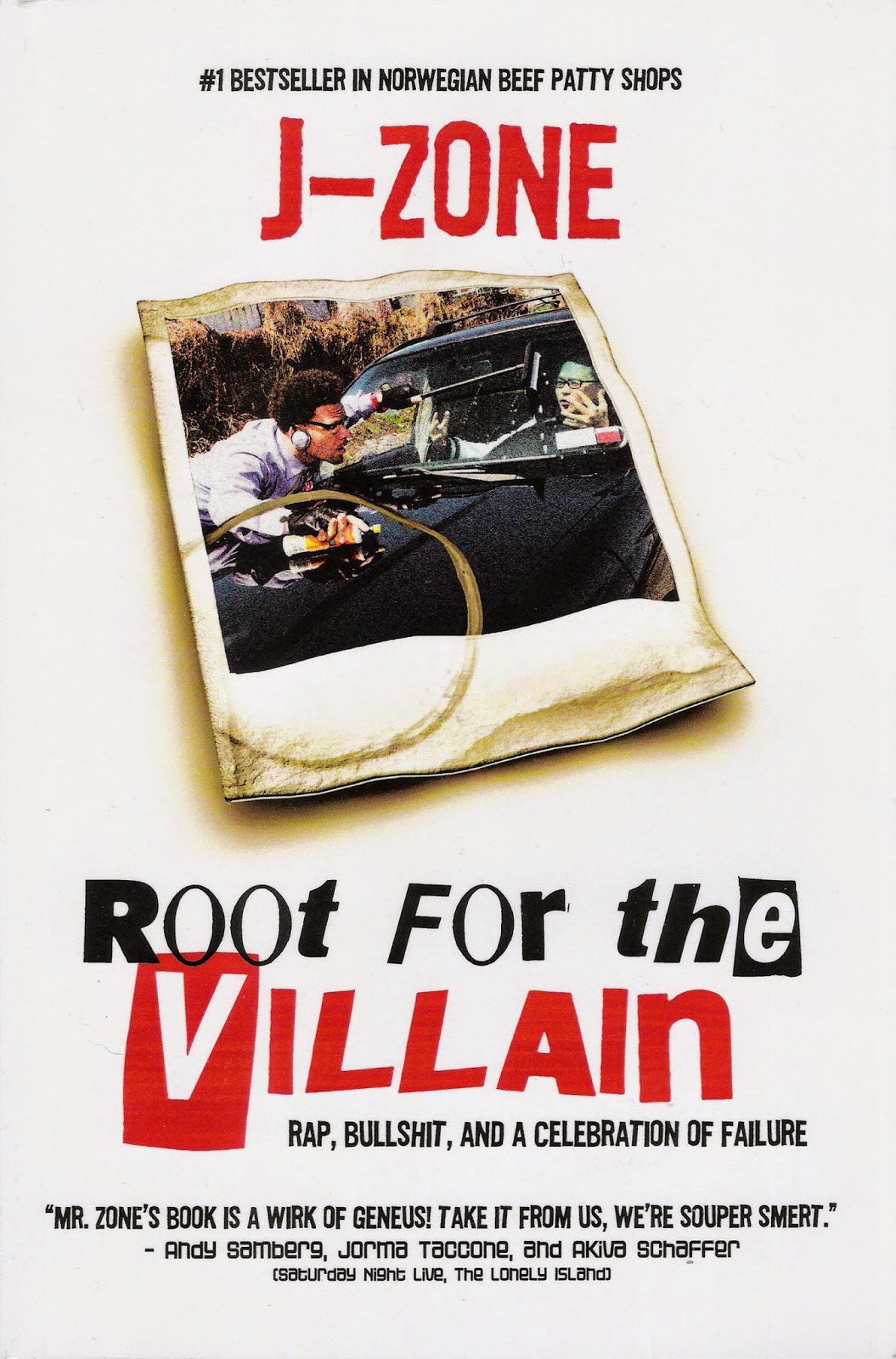
Root for the Villain


J-Zone Root for the Villain (2011)
I know this one's a bit outside the perimeter fence in terms of that which I would ordinarily scrutinise here, but it was a Christmas present; M.R. James' ghost stories were boring me shitless; it's probably not significantly further outside the perimeter fence than Turbulent Times as was inspected a few months back; and if anyone's actually reading this without access to the first four Spice 1 albums, then clearly there's no harm in a little edumacation on that score, particularly as there's no extra charge; so shut up.

J-Zone is a failed hip-hop artist in terms of selling truckloads of records and lighting cigars with hundred dollar bills whilst broiling in a microphone shaped jacuzzi, but as someone responsible for a good few entirely respectable tunes, he remains a contender regardless of reputation. I first came across the guy not through his music but when he began writing the Ign'ant column for Hip Hop Connection magazine, thus obliging me to carry on buying the fucking thing despite half the page count being given over to De La Soul every three months. Ign'ant celebrated all of the stuff that had become marginalised as the province of pugilist thickies in the remainder of the magazine, the stuff with which I was self-medicating in order to keep myself from quite literally going postal at work. Ign'ant rated its classic albums by quota of cusswords, drive-by shootings, and alleged kidnappings, immediately acknowledging that sometimes that sort of shit ends up on a record because it upsets you, and because it's funny that you're upset. Ign'ant is one of the greatest bits of writing to ever appear in a periodical, so when I learned that our boy had come up with a whole book of this shit, I knew just what to ask Santa.

Root for the Villain is probably an odd mix in some respects, thoughts and essays on rap and hip-hop served in an autobiographical sauce, with some other stuff at the end once we've run out of life story; but it's all gripping, fascinating and often shit-the-bed funny without even really trying. Rap publishing seems to be a bit of a minefield judging by the few things which have made it onto my own shelves, possibly because the harsh, cold daylight of written text tends to reveal that which is obsessed with keeping it real as generally keeping it less real than claimed; but J-Zone keeps it so real that it hurts when you sit down. There's no showboating here, just honest tales of digging in the crates for obscure Kool & the Gang eight track cartridges and taking a beating from your own octogenarian grandmother; now th8t'z gangsta, as Tim fucking Westwood would probably say because he read it somewhere.

J-Zone put the aforementioned grandmother on the cover of his first album, by the way, and chapter twenty-three asks Are Men the New Women?; and if that doesn't give you some idea of how badly you need to read this book, then screw you.

Monday, 5 January 2015

Dandelion Wine


Ray Bradbury Dandelion Wine (1957)

I think I started this one three or four times before I really began to get into it, on each occasion rapidly losing enthusiasm and switching to The Coming Race, or Earth Abides, or The Mind Parasites. Dandelion Wine is loosely autobiographical, constituting an attempt to recapture not only childhood, but to recapture childhood as perceived through the eyes of youth with all colours and sounds brighter and so much more meaningful than they appear in later years when rods, cones, and brain cells have turned to semolina. It does this exceptionally well with a richly evocative prose bordering on - I suppose - a sort of magic realism. In fact it does it so well that the honeyed tone of the text takes some getting used to, or at least it did for me, never quite turning into narrative Thomas Kinkade, but at times making your average episode of The Waltons seem like The Cabinet of Dr. Caligari.

Nevertheless, at last getting beyond the first twenty pages, Dandelion Wine proves itself worth the effort as the warmly orange glow of nostalgia is contrasted with a well drawn measure of childhood terror:


There were a million small towns like this all over the world. Each as dark, as lonely, each as removed, as full of shuddering and wonder. The reedy playing of minor-key violins was the small towns' music, with no lights, but many shadows. Oh, the vast swelling loneliness of them. The secret damp ravines of them. Life was a horror lived in them at night, when at all sides sanity, marriage, children, happiness, were threatened by an ogre called Death.

The point of this is of course that you can't really have the good stuff without the more nightmarish elements. The detail of the book is wonderfully gauged, presenting a child's typically obsessive focus on the minutiae of ritual, and a juvenile associative understanding of a world in which old people may well have lived forever and you really can build such a thing as a happiness machine if you know how to go about it. Even more impressive is the simultaneous contrast of a seemingly endless summer experienced with the urgent childhood awareness of running out of time, and that everything must either cease or change.

That said, or at least acknowledged, I did feel that Dandelion Wine rambled somewhat, and possibly could have done a better job with a lower page count; but then I've met people who regard this as an essentially perfect novel, so I'm fairly sure it's just me, as suggested by the difficulty I had getting started with it in the first place.

Wednesday, 17 December 2014

The Mind Parasites


Colin Wilson The Mind Parasites (1967)

Once was that I held Colin Wilson in relatively high regard, at least as the one author of cranky pseudoscience literature who stood a chance at being right about some of it. Somebody had given me a copy of Mysteries, of which I read about half. I tried it a couple of times, on each occasion losing interest around the halfway mark, at which point Colin started bringing in theories too wacky even for me. Later I realised that most of the good stuff had actually come from T.C. Lethbridge who wrote some broadly fascinating books about dowsing and the like. Mysteries tied Lethbridge in with some of Wilson's own ideas, most notably the one about a ladder of selves, which seems to work quite well as psychological analysis without requiring that one should take it as a literal description of the mechanism of the human mind.

Later I picked up The Outsider from a charity shop, but ended up giving it away because I couldn't be arsed to read it. The Outsider was amazing according to apparently everyone, an important book in the truest sense; and then my friend Paul Woods, who I seem to recall having had some dealings with Wilson in his capacity as a criminologist, always spoke very highly of the man, albeit not quite so highly as Wilson spoke of The Mind Parasites, his own novel:

Is it not time that we create a new type of novel? I think of a hatchet biting into a tree and making the chips fly, not an evasion of reality or a description of it, but an attack on it... What is needed is an existential realism. Like the social realism of the Soviets, yet biting much deeper; its attitude is not passive or pessimistic. In a qualified sense, it might be called practical; it wishes to change things. What it wishes to change I prefer to leave unsaid, it can be inferred from this book.

Really? This was a new type of novel? I was expecting some sort of - dunno - a mash-up of William Burroughs, Jean-Paul Sartre, and Guy Debord, massive ideas flying about left, right and centre, a book reading like nothing I have ever read before.

The Mind Parasites gets off to a tremendous start as a more contemporary take on Lovecraft's squelchy mythology with mysterious blocky cities discovered several miles underground, events unfolding with the chilling realism of a Quatermass serial; after which it all goes very much tits up. The underground city is revealed to have been a red herring for reasons which either remain unclear or are so poorly described that I've forgotten them. The true culprits are the mind parasites, malign incorporeal entities dwelling in the depths of the collective unconscious, or some other place which probably makes more sense if you've read either Jung or Huxley. These entities are the cause of war, racism, cruelty, inequality, suicide, boredom, accidents at work, and Doctor Who having been shite since it came back on the telly. Were it not for them we would all be telepathic supermen, at our full potential and qualified to lead the common herd of humanity to its destiny and all that good stuff. The thing that bothers me is that I suspect Wilson may actually have believed at least some of this crap.

A few years ago I made fumbling attempts to identify a literary genre which I provisionally named dinnerpunk based on it comprising poorly written yarns which come to their authors as they mow the lawns of their Surbiton homes as Marjorie is preparing dinner. They've read Biggles, several Ian Flemings, and it can't be that hard considering some of the fairies who make a living of it, so they're jolly well going to have a go. Dinnerpunk fiction tends to be written from an entirely male perspective, suggests a conservative view of the world, usually one fixating on some peculiar detail such as aviation history - because nutters are always into planes for some reason - and amongst the cast of chaps and renowned scientists, there's nearly always somebody identified simply as the Colonel. Dinnerpunk is the written equivalent to Bob Mortimer's Graham Lister character. It knows doctors and dentists, professional people...

Regrettably, after the tremendous start described above, The Mind Parasites reveals itself to be not merely a disappointment, but to be fully-leaded weapons grade dinnerpunk.

Neither is there any evidence to indicate that the crew of the Pallas intended to build a new civilisation on another planet. There were only three women on board. The number would surely have been higher if any such plan had been contemplated?

I should jolly well, say so. Our heroes are a team of top scientists who travel around in a gang of about fifteen for most of the book, routinely pooling their psychic powers to make the world a better place. Human history is a litany of woe thanks to the mind parasites, because it was them what made us do all that bad stuff like Hitler and that, which ironically is itself a typically right-wing narrative, the enemy and source of all woe being those people or things over there; it's because of them that we can't have nice stuff. Freed of the mind parasites, we are able to travel around in gangs of fifteen making stuff more good, even psychokinetically sending the moon crashing into the sun because that was where the mind parasites was all coming from innit. Except the mind parasites are actually ourselves, or at least ourselves what have failed to evolve into thinking, reasoning supermen, people who know doctors and dentists. Meanwhile the black nations of Africa unite and rise up against the white man because the mind parasites make them do it innit, just in case you mistakenly thought they might have had any other better reason to be pissed off.

Frankly, it's a complete fucking dog's dinner besides which even Lindsay Gutteridge's dinnerpunk tour de force Cold War in a Country Garden may as well be The Mayor of Casterbridge. The psychological discussion amounts to pseudoscientific bollocks of the kind which invariably namechecks Velikovsky, Gurdjieff, Madam Blavatsky and the usual wankers; there's barely a story to speak of; and there's a faintly unsavoury aftertaste of Hubbardry - telepathy, Nietzsche, supermen blah blah blah - except Hubbard could at least string a decent story together. This is like bad van Vogt stripped of all charm and art.

He had a shuddering distaste for most human beings; he once complained to me that most of them seemed so unfinished and shabby. Myers made me feel that the true historian is a poet rather than a scientist. He once said that the contemplation of individual men made him dream of suicide, and that he could reconcile himself to being human only by considering the rise and fall of civilisations.

I suspect Colin Wilson, whilst he may have been prone to a degree of ukippery, probably wasn't entirely a man without merits, but none of them are to be found in The Mind Parasites which was most certainly never a new kind of novel by any description. It's not often that I'm driven to such harsh words with regard to a book, but this really was a complete load of shit.

Wednesday, 10 December 2014

Earth Abides


George R. Stewart Earth Abides (1949)

The immediate wake of the second world war most likely seemed an appropriate time for consideration of worlds wiped clean of all but a scattering of humanity, I suppose that being the era during which it was made particularly apparent that some disasters could occur on a global scale if the political wind was blowing in a certain direction. George R. Stewart avoids the politics, cleaning his slate with an unexplained pandemic which at least allows him to concentrate on the issue of survival and how one might go forth after the fall of human civilisation; so despite the circumstances, Earth Abides at least kicks off on a positive note as something seeking solutions rather than simply identifying problems. The initial resemblance of Isherwood Williams' situation to that of Robinson Crusoe stranded upon his island is deliberate and is acknowledged:

One day, wanting to shake himself out of his apathy, he went to the Public Library, smashed a lock with his hammer, and after some browsing found himself (a little to his own amusement) walking out with Robinson Crusoe and The Swiss Family Robinson.

These books, however, did not interest him greatly. Crusoe's religious preoccupations seemed boring and rather silly. As for the Robinsons, he felt (as he had felt when he was a boy) that the ship remained for the family a kind of infinite grab-bag from which at any time they might take exactly what they wanted.

Ish is alone for most of the first part of the book, feeling his way and learning how to get by, mapping out the full extent of that which has been lost or which no longer applies:

As the world now was, a Pharisee or Sadducee might perhaps still follow the set rites of formalised religion, but the very humanity of the teachings of Jesus rendered them obsolete.

Accordingly the first part of the novel is arguably pastoral and maintains a tone not unlike that of Clifford D. Simak:

Looking out from the car, he saw only the handsome Dalmatian, sitting at the side of the road. Now being safe, Ish felt his attitude quickly changing. Actually the dogs had done him no harm, and indeed had not really even threatened him. During a few minutes he had thought of them as wild creatures thirsting for his blood. Now, they seemed a little pitiful, as if they might merely have been seeking the companionship of a man because of what they remembered long ago—of food laid out in dishes, of crackling logs in the fireplace, of a patting hand and a soothing voice. As he drove away, he wished them no bad luck, but rather hoped that they would manage occasionally to snap up a rabbit or pull down a calf.

Unfortunately for both the story and its protagonists, Ish and his small group of survivors come to rely upon their vanished civilisation much as the Robinsons did their ship, scavenging tinned or otherwise preserved food from the stores of deserted cities, living in vacated houses whilst the water and electricity last. Unable to let go of the past, they become a sort of cargo cult epitomised by one family who stock their post-apocalyptic home with top of the range consumer goods with nothing to power them. The group fails to adapt, just as we ourselves continue to fail to adapt to circumstances changing at ever-increasing rates, and so they are doomed even whilst the Earth itself abides.

The story is well told and makes a point worth making in easy, folksy terms, but the problem is that Earth Abides makes its point with the implausible metaphor of nothing much having changed two decades down the line. The survivors are still living in the ruined city, ranging ever further afield in search of goods canned more than twenty years earlier, and the fact that no-one has yet thought to do so much as plant a potato just to see what happens suggests that they're idiots, and it becomes increasingly difficult to feel sympathy. It's a shame for something which gets off to such a good start, and whilst it tries hard and kicks up all sorts of thought provoking ideas along the route, the whole ultimately feels unfortunately like a bit of a wasted effort. They get there in the end, abandoning the useless relics of what was and returning to social forms much closer to those of the Native Americans. I suppose Earth Abides needed to make the point of just why such relics should be discarded, but if felt like a long time spent learning a fairly simple lesson.

Sunday, 7 December 2014

The Coming Race


Edward Bulwer-Lytton The Coming Race (1871)
The Coming Race was hardly the first science-fiction novel to  rummage around within a hollow Earth. Journey to the Center of the Earth - to name but one of many - was published seven years earlier, and the general conceit probably goes back at least so far as Don Quixote's descent into the Caves of Montesinos in Cervantes' 1615 novel. The Coming Race would nevertheless appear to represent a seminal work of its type, and its popularity was once such as to seed public imagination with vril, the novel's mysterious energy source falling somewhere between nuclear power, electricity, telepathy, and the force from Star Wars. Mastery of vril is the reason for the technological superiority of that lot down there, as Bulwer-Lytton explained, inadvertently inspiring numerous occult types - Madam Blavatsky for one - seemingly ranging from those regarding vril as a metaphor for some existing esoteric force, to those apparently taking The Coming Race for fact disguised as fiction. Of the latter group one might arguably include Richard S. Shaver whose peculiar subterranean ramblings might be deemed heir to Bulwer-Lytton were they not so obviously sourced from a more personal, psychological mania, and vril seems to have become a totem for some of the weirder expressions of Nazism. Weirder still, at least to me, is that the name of Bovril, the popular pseudo-Marmitic English meat based drink derives from the idea of vril as life enhancing.

Anyway, before we go too far down that particular rabbit hole, it should be noted that Bulwer-Lytton's novel belongs more significantly to the utopian tradition, but taps into subterranean folk myth to a greater extent than others of its kind. The underworld as hell, if not uniquely Christian, seems to have been the exception to a general global rule. Most underworlds were traditionally a source of life, development, culture and so on, with the world as a metaphorical womb giving birth to the people and all which sustains them. This basic idea is found in Norse mythology, Sumer, Mexico, and pretty much everywhere else to greater or lesser degrees. Bulwer-Lytton's utopia is therefore home to a more developed race than our own, although the precise details of the warning delivered appear fairly loosely defined, or at least they did to me. Unfortunately I have a feeling this may be down to my own prejudices, specifically that which I expect to have been the sort of thing that would have mattered to a Victorian author of Bulwer-Lytton's credentials.

The Coming Race references ancient deluges in terms which suggest scientific foundations in the sort of catastrophism which squared fairly well with the emerging ideas of Darwinian evolution. Yet, whilst the novel appears to embrace Darwin up to a point, the Vril-ya - this being the name of the coming race in question - claim descent from frogs, which reads somewhat like a Christian parody of Darwin, not a million miles from the sort of critique asking where amongst its relatives was the orang-outang to be found. On the other hand, there's also the strong possibility that the supposed war between Church and Darwin has become somewhat exaggerated in recent times by the usual tub-thumping bores on both sides, and may not have been quite such a partisan affair as we have been led to believe. I suspect Bulwer-Lytton may not have given a great deal of thought to those aspects of his narrative which, with hindsight, seem as though they should be making some more strident observation, for he seems to find no contradiction in evolution discussed with such frequent references made to faith, and is more likely presenting a warning of the notion of progress as a virtue in itself. Progress was hardly a new idea in 1871, but the developed, or at least developing world was clearly still coming to terms with the idea of progress as something which could achieve such momentum as it did in the 1800s, and which had begun to reach into every aspect of modern life. Even humanity, so it seemed, was subject to progress, hence the disturbing possibility of more advanced expressions of humanity who might come to regard us as we did the less technologically orientated colonial subjects of the empire. Supermen and their mighty works would become popular during the century to come, notably with a great many folks who also enjoyed shouting and wearing uniforms, so it is interesting and possibly ironic on some level that Bulwer-Lytton describes the racial characteristics of the Vril-ya as close to Native American type, presumably by virtue of their having been the least understood ethnic group to have achieved levels of civilisation comparable to those of classical antiquity at the time of writing. Happily, the utopia of The Coming Race therefore constitutes relatively slim pickings for nutcases seeking Aryan material, excepting I suppose a few of the more obsessive Death In June types who could probably find some sort of ariosophic subtext in an episode of Dora the Explorer.

Established expressions of bullshit aside, The Coming Race is a fairly straightforward prompt towards the conclusion implied by Victorian notions of progress, that we might not necessarily be the pinnacle of God's creation, and that this is worth keeping in mind. Oddly I find this echoes Dostoyevsky's Crime and Punishment in that it too makes a lesson of the perils of ideology becoming too far divorced from the reality it endeavours to inform, which is of course the big problem with most versions of utopia. I personally found this one a little more readable than Crime and Punishment, although I can see why it has failed to remain quite so popular as at least a few of its contemporaries, lacking as it does the wit and verve of Verne, Wells, Shelley and others - not a bad novel by any stretch, but one that was quite definitively of its time; and although I'm sceptical that Bulwer-Lytton can really have been said to have predicted nuclear energy, the appearance of robots in a novel published in 1871 is not unimpressive.

Monday, 1 December 2014

Captain America: The Captain


Mark Gruenwald, Kieron Dwyer & Tom Morgan
Captain America: The Captain (1988)

Having watched A Brony Tale, the documentary examining the phenomenon of Bronies - adult and generally male devotees of My Little Pony: Friendship is Magic - I availed myself of my nearest internet to opine that the notion of adult males dedicated to a cartoon show very specifically aimed at little girls struck me as lamentable. Naturally my observation was called into question by those who had somehow misread my comment as a call for something to be done about this situation, perhaps a rounding up of those accused so that they might be forced into camps and trained to take culture seriously because I was one of those snobbish cultural Nazis pompously declaring Wagner's Der Ring des Nibelungen superior to The Care Bears Movie when actually it wasn't because it's all about how you feel and stuff. I found this aggravating because it entirely missed my point, my point being that while I'm all for folks taking their pleasure where they find it, it's nevertheless depressing to see what I would respectfully identify as either more vital, sophisticated, or at least less corporate expressions of culture relegated to a dusty old trunk in a disused museum merely because it's too hard to think about stuff that isn't like totally awesome and like no-one cares about that boring old shit. It's elitist of me, I realise, but I'm running out of decent conversation, and I don't wish to find myself on my deathbed surrounded by shit-brained Pokémon champions quoting lines from the fucking Big Bang Theory because expecting anyone to grow up or even attempt to better themselves in any sense has somehow come to constitute a human rights violation.

Part of the reason I feel this way is, as I approach my fiftieth year, I sometimes wish someone had taken me aside back in 1987 just as I was about to blow another fifty quid on X-Men comics and pointed me in the direction of some of that which I am only now beginning to appreciate. Actually, someone probably did just that, but without the levels of righteousness necessary to get their point across; although I suppose we each of us have to get to wherever we are going in our own way, and at least I got there in the end, more or less.

So here's me, a full grown man reading Captain America rather than giving Crime and Punishment another go like the square-headed uptight opera loving culture Nazi I apparently am. The thing is here - I would hope - that I try to vary my input, keeping it broad up to a point, in contrast to an exclusive diet of inconsequential logo driven crap; and so I am able to appreciate this collection as something suggested for ages of nine and up, but hopefully not all the way up, without the same figure necessarily referring to my emotional and intellectual development; and so to business...

I'm not exactly sure what it was about Mark Gruenwald's Captain America that appealed to me given its being very much a traditional superhero title, and arguably at the other end of the spectrum from all the X-Men stuff upon which I was blowing my dole money. Possibly it is the very simplicity of the character and the idea, just some bloke dressed like a flag - it would be pop art were it a little more self-aware, which thankfully it wasn't. There's something honest about Captain America as an idea, an optimistic quality perhaps sprung from the how far our reality falls short of such ideals as are sketched here in three basic colours. In the wake of Watchmen, as comic book writers were busily infecting their characters with AIDS or having them arrested for shoplifting in pursuit of that grown-up dollar, Captain America was going up against the Serpent Society - a band of crooks in snake costumes; 'You look hungry,' his partner Nomad quips to Famine the mutant supervillain as they fight, 'have a knuckle sandwich!' and on every other page we find plot and motivation tirelessly reiterated and reinforced as thought bubbles.

'It's not my fault I've had rotten breaks all my life,' Diamondback silently reflects as Captain America races off in pursuit of the Viper. 'All it would take is the love of a good honest man like you and I could be a good person! A hero even! How can I make you see that?'

So you get the picture - this was closer to Roy Lichtenstein source material than Grant Morrison having post-ironic chuckles with pointedly hokey characters; and yet Gruenwald managed to turn the whole thing upside down and inside out without so much as a sly wink to camera, having the American government fire Captain America in order to replace him with someone more likely to toe the line, and less likely to ask awkward questions when assigned to protect America's corporate interests. It could have gone horribly wrong, or at least horribly condescending, but Gruenwald never lost sight of his audience or what they expected for their seventy-five cents. The run of comics collected here follows our hero as he's replaced by a well-intentioned bigot, in the process smuggling all sorts of uncomfortable questions under the radar - free speech, the constitution, abuse of the constitution, government corruption, and even a sneaky poke at US involvement in Nicaragua; and it does all of this without turning into Brought To Light, or doing anything too likely to alienate even budding Republicans, let alone third graders. Of course, one might argue that it cops out in the end with the source of corruption revealed as Red Skull's efforts to subvert a presumably otherwise honorable American government from within, and whilst this is no more implausible than anything else in this sort of spandex narrative, it comes late in the day and the point has already been made. We've already seen the light glinting from President Reagan's curiously serpentine fangs as he stands to address the nation, assuring us that both he and Nancy are fully recovered from having been turned into hybrid reptile creatures by the Viper a few pages before.

I was drawn to this collection by pure nostalgia, almost certain that it would have dated terribly on the grounds of my having been somewhat less literate when first I read it; and happily I am mistaken, not because this run of Captain America was Noam Chomsky in a star-spangled leotard, but because Gruenwald was a great comic book writer who exactly understood his very young audience and was able to communicate some pretty important ideas without talking down to anyone or skimping on the generic superhero thrills and spills. It's a shame that the kind of spirit in which this was produced seems less evident in the brand driven kid's entertainment of today.