Showing posts with label Jean-Paul Sartre. Show all posts

Friday, 6 June 2025

J.D. Salinger - The Catcher in the Rye (1951)


I read this mainly because it had begun to feel a bit weird that I hadn't, given the shadow it casts across various stretches of popular culture. Having been found in the pocket of the bloke who murdered John Lennon, and then again in the fictional narrative of Margaret Thatcher's aspiring assassin in Grant Morrison's St. Swithin's Day, I'd always assumed Catcher to be about a neurotic outsider who flips and consequently pops an innocent with a firearm - the blueprint for all those school shootings. Thankfully it isn't anything quite so obvious and the general concept of both teenagers and their inherent disgruntlement was still very much in development back in 1951.

So Holden Caulfield isn't the tidily modular rebel who rejects whatever you've got on principle, but rather is someone who has failed to connect with aspects of his own existence - like a more freewheeling version of Roquentin from Sartre's Nausea, the first English translation of which had appeared just two years earlier, it might be noted. My own stepson had a couple of years at one of those supposedly prestigious military academies to which Americans with too much money send their offspring, and so I recognise Caulfield's environment, finding it both reassuring and depressing that someone else identified the exact same problems with such places over seventy years ago. Caulfield isn't a bad student, or a kid with any  psychological issues which would today be medicated to drooling oblivion. It's simply that he's just smart enough to recognise bullshit when he sees it and struggles to reconcile himself to what is expected of him, most of which is predicated on the existence of a noble world full of grand achievements, aspirations, and fine men delivering speeches in front of marble columns, as distinct from a world made entirely of bullshit. He's been taught to hold truth as among the highest of virtues and so cannot help but revolt against that which it reveals. In practical terms, this amounts to his dropping out of school and vanishing off into the wild, blue yonder over the course of a weekend, as told in rambling first person with endless digressions and passing distractions in Caulfield's own distinctive if occasionally limited turn of phrase. You might argue the case for it being a more populist Nausea with Caulfield, lacking Roquentin's philosophical rhetoric, obliged to define his disconnection in more familiar terms, or terms with which I was more familiar at least.

It isn't a literary precursor to Ill Bill's Anatomy of a School Shooting, despite the reputation, being concerned with cause more than dramatic effect, and I doubt it would have endured so well were that the case.

Friday, 31 May 2024

Stricture


Isabelle Nicou Stricture (2022)
Here's another which qualifies as a proper book, with bits I didn't understand and everything; although to be fair, Nicou's prose - or possibly Kaycie Hall's translation from the original French - is precise and clear in its description of people, events, and the ambiguous or even fantastical means by which they are associated. I'd say it's this last aspect which fosters the atmosphere of a waking dream, which leaves us unsure as to what we've just read.

Nicou's seemingly pseudo-autobiographical character is a young woman attempting to make sense of having been in thrall to her mentor, a professor of philosophy; and the existential hinterland of her musing as she strives to break free draws associations with King Lear, the science-fiction of Jules Verne, and alien abduction, amongst other examples of magical thinking. It's a cloud of shifting meaning somehow rendered in sharp focus which remains nevertheless quite difficult to describe beyond listing a few of the sign posts. Probably inevitably, reading Stricture felt a little like reading Sartre's Nausea - albeit without the undercurrent of revulsion - which possibly may say more about how little French literature I've read than it does about what Nicou was trying to do; but, for what it may be worth, I kept reading Stricture because it felt as though I was getting a lot from it, even if what that was eludes easy quantification.


Tuesday, 8 June 2021

Our Lady of the Flowers


Jean Genet Our Lady of the Flowers (1943)
I didn't get on very well with The Thief's Journal but somehow picked up the idea that this was the one I should have read; so now I've read it.

Genet wrote Our Lady of the Flowers in prison with a broken pencil and sheets of brown paper squirrelled away from whatever forced labour the authorities had deemed might keep him out of trouble. The manuscript - because I suppose that's what it was - was found and destroyed at some point or other, probably by another jailbird - and so Genet started again; although I suspect it was probably more the case that he simply carried on given that the novel comprises philosophical musings entangled around a vivid fantasy existence, so the narrative structure seems pretty much analogous to what happens when you twist a spigot. I doubt the destruction of the earlier draft has deprived us of any particular episode or insight which hasn't been regurgitated here.

Genet was a petty thief, amongst other things - barely even a decent criminal - someone so profoundly unlikely to ever fit in that he's barely even a snug fit within his own mildly transgressive mythology, but his writing was powerful, vividly poetic and arguably unique, even if a little goes a long way. Our Lady of the Flowers is horribly self-indulgent to a point bordering on masturbation, rendering it somewhat impenetrable to the casual reader, which seems to have been Genet's intention - specifically art without compromise and which is absolutely true to itself.


The world of the living is never too remote from me. I remove it as far as I can with all the means at my disposal. The world withdraws until it is only a golden point in so somber a sky that the abyss between our world and the other is such that the only real thing that remains is the grave. So I am beginning here a really dead man's existence. More and more I prune that existence, I trim it of all facts, especially the more pretty ones, those which might readily remind me that the real world is spread out twenty yards away, right at the foot of the walls.


The subject is Genet himself as reflected in his brutally, cramped microcosm merged with that of his own imagination, and with very little dividing the layers. So we don't hear a great deal about other inmates or humorous misunderstandings in the mess hall, and it will probably be some time before we see this adapted for telly with Ross Kemp donning the stripey pyjamas, but we spend a lot of time inside Genet's head, populated mostly by homosexuals, drag queens, pimps, addicts, and other refugees from some Lou Reed album. I suspect my description may here strike a potentially contentious note, although I feel that to adopt drearily empowering contemporary terms would be doing both Genet and the reader's intelligence a disservice.

Society generally took a dim view of homosexuality in Genet's day, and Genet conflates his own sexuality with its unfortunate associations, the bestial and perverse, the dirty and the irredeemable to an almost fetishist degree of association where even acts of betrayal and dishonesty seem to take on a near divine quality in which, as with certain Shamanic systems, sin approaches the sacred through existing beyond the limits of the ordinary and socially acceptable. Anyone requiring parables of honour amongst thieves or the dignity of the outcast is unlikely to find anything here.


I might, just as she admitted to me, confide that if I take contempt, but rather in order not to be ridiculous, not to be reviled, by anything or anyone, that I have placed myself lower than dirt. I could not do otherwise. If I declare that I am an old whore, no one can better that, I discourage insult. People can't even spit in my face any more.


Of course, it's a defence mechanism to some extent, but any self-flagellation involved should be taken as essentially celebratory, a relishing of sin without attempts to turn it into anything more conventionally noble.


I want to sing murder, for I love murderers. To sing it plainly. Without pretending, for example, that I want to be redeemed through it, though I do yearn for redemption.


Our Lady of the Flowers is therefore, from one angle, Genet maintaining his sanity by modelling his world in something approximating his own image, and the act of writing it down may be what made it real, or at least real enough for his purposes.


But I know that the poor Demiurge is forced to make his creature in his own image and that he did not invent Lucifer. In my cell, little by little, I shall have to give my thrills to the granite. I shall be alone with it for a long long time, and I shall make it live with my breath and the smell of my farts, both the solemn and the mild ones. It will take me an entire book before I draw her from her petrifaction and little by little impart to her my suffering, little by little deliver her from evil, and, holding her by the hand, lead her to saintliness.


Despite an erotic undertone, I'm not convinced that it's really about sex, gender identity or anything involving orifices, and sexually ambiguous males such as Darling, Our Lady and the rest drift in and out of the visionary narrative perpetrating small acts of betrayal upon one another apparently for the sake of mapping the territory. Indeed, to colonise Our Lady of the Flowers in service of gender theory - as I see has already been done in a few bits of internet - seems reductionist and divisive when all the information one might require is already to be found explicitly stated in the text.

Which is all very nice, but actually reading the thing night after night is exhausting because Genet writes entirely for himself, leaving the rest of us to make the best of it. When he says something interesting, it's wonderful, like crisp sunlight breaking through grey cloud in the wake of a storm, but such instances are few and far between, presumably unless one treats the whole as poetry, taking it slowly, one paragraph at a time. Without it representing any sort of failure on Genet's part, given what he was doing with this novel, Sartre's fifty-page introduction is a lot more engaging and a lot more enlightening. None of which is to say that Genet wasn't a great writer, or that he lacked philosophical depth, or even that this work shouldn't be considered a masterpiece - because it probably is by some definition - but I nevertheless found it a chore and I guess Genet just isn't for me. I tried, and I'm glad I tried, but there it is.

Tuesday, 29 October 2019

The Thief's Journal


Jean Genet The Thief's Journal (1949)
I'm not quite sure what brought me here, but it was probably something to do with Amphetamine Sulphate given that, with hindsight, The Thief's Journal seems ancestral to at least a couple of their titles, notably Josiah Morgan's Inside the Castle.
 
Genet - as I will freely admit I didn't actually know until I looked it all up about a month ago - was a petty thief of no consistently fixed abode who took to writing and so caught the attention of Jean Cocteau and other poetic types of his generation. The Thief's Journal is approximately autobiographical in being an account of Genet's existence on the periphery of the law, but rather than reading as a straight narrative comprises a flowery existential analysis which sporadically refers to events from Genet's life, mostly nicking stuff and encounters with men's cocks - these being the main reasons for its apparently having been embraced as transgressive literature, on which subject my friend Paul Woods had this to say:

I liked the couple of early books I read of his when I was a kid and enjoyed a couple of his plays which I saw in filmed versions, but I never really got why the transgressive literature label was applied to him. I suppose it might be straight literati types getting all excited about a writer who's actually from the underworld. I was reading a biography of Genet when I was on a mini-tour with Damo early this year and it struck me that, for someone who called his own semi-autobiog The Thief's Journal, he was pretty piss-pathetic as a thief - stealing shirts and books from Paris shops. More of a failed kleptomaniac really. I remember when my old man had been home from the nick for a couple of years (who really did earn the title of professional thief - or recidivist from the law-enforcement point of view) and he took my copy of The Thief's Journal off the shelves to read. A night or two later he comes in the living room, points at me, says, 'You're fucking mad!' and walks out again. I suspect that may have been old Jean's description of dropping his drawers to other men to earn a crust.

Anyway, Genet takes an aesthetic position loosely comparable to that of Esseintes in Huysmans' Against Nature.

Abandoned by my family, I already felt it was natural to aggravate this condition by a preference for boys, and this preference by theft, and theft by crime or a complacent attitude in regard to crime. I thus resolutely rejected a world which had rejected me.

It's also comparable to certain Shamanic ideas informing members of the priesthood in Mexica society before the conquest, specifically their embracing the filthy, the unclean, and the transgressive as pertaining to the sacred through existing beyond the limits of the traditionally acceptable. Genet therefore finds endless beauty in the world he inhabits.

The beauty of a moral act depends on the beauty of its expression. To say that it is beautiful is to decide that it will be so. It remains to be proven so. This is the task of images, that is, of the correspondences with the splendours of the physical world. The act is beautiful if it provokes, and in our throat reveals, song. Sometimes the consciousness with which we have pondered a reputedly vile act, the power of expression which must signify it, impels us to song. This means that treachery is beautiful if it makes us sing.

The Thief's Journal is therefore mostly about Genet finding poetry, and unusually florid poetry, in dirt, poverty, degradation, shame, small acts of betrayal, and a seemingly never ending procession of men's spunky cocks - this novel having been written back when homosexuality was a somewhat more contentious subject to the point of representing an open act of rebellion against some notional natural order. So as with Sartre, then Debord, William Burroughs to some extent, and more recently the aforementioned Josiah Morgan, it's actually about how reality relates to our perception of the same, or something in that general direction.

Unfortunately, whilst Inside the Castle - for one example - was a punchy forty pages or thereabouts, The Thief's Journal is more than two-hundred, allowing me ample scope to tire of endless descriptions of men's amazing cocks to the point of turning to Fred and Judy Vermorel's Sex Pistols biography on a couple of evenings for the sake of reading something which didn't feel like homework. I can appreciate both Genet's craft and his philosophical depth - if that's what I mean - but other's have done this sort of thing better with significantly less droning.

Tuesday, 15 January 2019

Fantastic Four versus the X-Men

Chris Claremont, Jon Bogdanove & Terry Austin
Fantastic Four versus the X-Men (1987)
I chose this as light bedtime reading on evenings when it seemed like Philip K. Dick's Exegesis might be a bit too much, which could justifiably be characterised as a retreat into childhood - although I was twenty-two when I first read this and not technically a child, just emotionally behind and lacking in worldly experience.

I brought the occasional Marvel comic back from school when I was a kid, usually borrowed from a friend. I quite specifically recall my mother sneering with unusual severity at the cover of Spiderman Comics Weekly #111, which would have been January 1975*, and which imprinted on me the idea that these things were trashy, shameful, and therefore forbidden. Normally she wouldn't have seen the comic but I had to get a parental signature so that I could join FOOM, or Friends of Old Marvel.

I didn't really go anywhere near superheroes after that, excepting a few issues of the Defenders and something or other reprinting the Inhumans. 2000AD and Doctor Who met most of my science-fiction needs and didn't seem to draw quite such opprobrium, possibly because there was no-one wearing a cape on the cover, meaning they could therefore be smuggled past the border patrol as something faintly cultural by virtue of not being American.

Then within about a year of leaving home at the age of eighteen, it suddenly dawned on me that I could now read that caped shit until my eyes hurt, and there was no-one to stop me. Furthermore, I now had the means to buy many different titles thus enabling me to keep track of what the fuck was going on in the wider Marvel universe. Part of the appeal of the Defenders had been the glimpse it afforded of a more expansive but otherwise mysterious narrative. I slipped into monthly expeditions to Forbidden Planet up in that London, usually spending about fifty quid at a time. I accrued a massive collection of American comics. Then around '92 it became obvious that I had to shed some of what I had accumulated for practical reasons, and it was mostly the Marvel stuff. Rob Liefeld had become involved and the current titles had all turned to shite, plus it seemed like a clean break might not hurt - kicking the habit as though it were an actual chemical addiction, all or nothing, and most of the caped stuff went.

Thirty years later, my curiosity has built such a head of steam that I've started buying back all those issues I once owned, which as mid-life crises go is probably healthier than sports cars or banging teenagers. The element of curiosity is my specifically wondering how bad those comics really could have been given that they clearly meant a lot to me at the time; and would the magic, whatever it was, have endured? Strangely, it has in most cases, despite my now reading these things with more brain cells at my disposal, being arguably more educated and more emotionally developed. I cleared out the caped stuff because it struck me as childish and therefore symptomatic of my own immaturity, and of course I held onto all that sophisticated stuff by Alan Moore and the rest; but only now have I noticed that this was itself an immature perspective.

I'm reading Watchmen instead of X-Factor. I'm a big boy now!
 
Anyway, I read the Mephisto limited series a few nights back. It was a lot of fun, but definitely a children's comic, and there's not much more to be said about it. Fantastic Four versus the X-Men is likewise a children's comic, but one written by Chris Claremont which might therefore be seen to epitomise everything which drew me to the genre and then kept me reading.

The story is fairly simple. Shadowcat of the X-Men is unwell and only Reed Richards of the Fantastic Four has the scientific knowhow to save her, but he experiences a crisis of confidence and refuses, fearing he will only make the situation worse. Dr. Doom, mortal enemy of just about everyone but also a brilliant scientist steps in, offering to cure Shadowcat; and they all have a fight.

Where Claremont succeeded was emphasising the soap opera aspect of these stories, and either sufficiently downplaying the more ludicrous elements of the genre so as to keep them from getting in the way, or else disguising them as something more like science-fiction. So maybe the superpowers, mutant or otherwise, are preposterous, but by passing our guys off as sympathetic monsters, we never have to think about the truly stupid stuff such as why anyone would dress up as a bat in response to the death of their parents, or even the absurd frequency with which strangers need rescuing from burning buildings. Instead of something which pulls towards the status quo of upholding justice and jailing bad guys, the world of our mutant superheroes is actually pretty fucking weird with plenty of wiggle room for shifting moral foundations, playing on the sort of subjects which will tend to preoccupy all but the most stupid teenagers. This dovetails nicely with that thing about comic book narrative being a case of messing up everyone's lives and then trying to get them straightened out - reforming the villainous Magneto as a sympathetic character for one. Claremont did this a lot, but framed his dilemmas in such a way as to present the illusion of there being something real at stake. Here we have Shadowcat, whose molecules are drifting apart, faced with her own extinction, and the writing, pacing, timing and art are so perfectly judged as to evoke genuine tragedy.

Claremont writes in the tradition of Stan Lee, moving his story along with a third person subjective narrator prone to rhetorical questions in Marvel Shakespearian.

Did you really think to do that much, Reed Richards?

As narrative, it's the opposite of Warren Ellis trying to fool us into thinking we're watching a film. It's chatty and probably a bit camp, but as with anything, you have to make some effort to work with the genre rather than expecting Sartre with capes and superpowers - an approach which will lead only to disappointment.

Here Claremont tells a story spelled out in huge, brash brush strokes with everything sign posted and plenty of sentiment, and somehow he gets the balance absolutely right, resulting in a story which is never too much or too little of anything, meaning that while it remains a book which seems obviously aimed at ten-year old boys, I can still read it at the age of fifty-three without feeling like I'm watching Dora the Explorer; because the elements which keep it interesting - the shock of the weird and the soap opera - don't speak to any one specific reading age.

I'm really glad that I grew up so much as to be able to read this sort of thing again.

*: I had to look this up, scanning through page after page of internet to find a cover I recognised. This search has additionally brought to my attention the fact of this particular issue having been drawn by Gil Kane, so I probably shouldn't have placed so much stock in my mother's verdict on this occasion.

Monday, 24 September 2018

The Outsider


Albert Camus The Outsider (1942)
Here's another one I probably should have made the effort to read thirty years ago, but better late than never, I suppose. The Outsider is the deceptively straightforward tale of an average man committing murder for no good reason, placed on trial, then sentenced to death. The prose - admittedly the translated prose - is tight and efficient, sticking to the basics without quite succumbing to the shorthand of a thriller. It passes along with so little drama that one begins to wonder what all the fuss has been about, where is the ponderous depth most of us will have anticipated? The revelation comes in the last few chapters as we recognise themes which, so it turns out, have been there all along.

I heard something that I hadn't heard for months. It was the sound of a voice; my own voice, there was no mistaking it. And I recognised it as the voice that for many a day of late had been buzzing in my ears. So I knew that all this time I'd been talking to myself.

The Outsider has been described as an existentialist novel, and its central figure is distanced from his own existence in much the same way as Nausea's Roquentin, but its thoughts are otherwise elsewhere. At the risk of sounding like Fred Flintstone attempting to get his head around A Brief History of Time, my reading is that the novel is about morality in the absence of God, or specifically how we relate to it, if at all, having decided that we're done with all the melodrama and gnashing of teeth undertaken for the sake of appearance. Meursault observes his own life and subsequent detention as though it's all happening to someone else, which Camus seems to propose is what is left once you subtract the hysterics, and what is left is faintly absurd because life is faintly absurd.

It's a quiet realisation, but its impact is significant once you realise what the book is doing; hence, I suppose, it's reputation as a classic.

Tuesday, 14 August 2018

Words


Jean-Paul Sartre Words (1964)
Words is Sartre's dissection of his own formative years, revealing the composition of the soil in which his person, and by extension his later writing, was rooted. The surprising thing, at least to me, is how much of the later Sartre seems to have already been fully-formed and living his juvenile years like some kind of experiment designed to test the relationship between reality and our understanding of the same. Of course, there's not much point pretending he was literally thinking of anything in terms which would have directly made sense in Nausea or Age of Reason, but neither does it seem useful to read this as old man Sartre retroactively superimposing a narrative on his own childhood. He reads, he writes juvenile adventure novels in exercise books, he exists within a family, and all of this is told as a continuous landscape of experiences - as distinct from the more traditionally autobiographical lists of names, dates, and yappy commentary.

Through my flights of imagination, I was trying to attain reality.

Without actively cracking jokes, there's a pleasant lightness of touch here - something in the line of a more ponderous Tony Hancock, which is as such very readable, even entertaining, whilst strongly foreshadowing what was to come; so it's Nausea Babies, roughly speaking.

Tuesday, 30 January 2018

Notes from Underground


Fyodor Dostoyevsky Notes from Underground (1864)
I didn't really get on with Crime and Punishment, and I bought this on the grounds of having heard of it and that Dostoyevsky must have written something to deserve all that reputation. It turns out that Notes from Underground is actually pretty slim, so it's fairly common to find it collected with other material as is the case here, and which presented the additonal appeal of containing shorter and hopefully snappier examples of whatever the fuck he was trying to say.

I got a little more out of it than Crime and Punishment, but otherwise I think I've learned my lesson. Here we have four tales from different periods of Dostoyevsky's life serving to illustrate an almost autobiographical narrative. Specifically, Dostoyevsky was subjected to a mock execution by tsarist authorities who regarded him as a subversive in 1849, then sent off to the stripey hole for the next eight years, all of which somewhat soured his view of humanity and his own initial idealism. We are afforded insight into the views of the young Dostoyevsky in White Nights, then his time in prison in selections from the autobiographical The House of the Dead, then Notes itself, concluding with The Dream of a Ridiculous Man which charts his descent into something resembling misanthropy.

The excerpts from The House of the Dead seem the most illuminating, and I found the most interesting, mostly consisting of straightforward reportage of the lives and crimes of those with whom Dostoyevsky shared a prison lavatory. The accounts are conversational, sober, and the crimes detailed are allowed to speak for themselves without any wringing of hands or pulling of faces, which is what spoils the rest of this material for me. It's nothing like so cloying or sentimental as Dickens, and the narrative often seems to actively resist the possibility with its focus on ugliness, contradiction, and self-loathing, its continuous refutation of idealism; but in the absence of light relief, it all becomes a little exhausting after a while. I suppose our man may have been attempting to communicate some purity of vision, albeit through grey-tinted spectacles, in encouraging us to dislike him as much as he seemingly disliked himself, but I found the effect unconvincing. White Nights was written prior to the author's time in prison, before the disillusionment had properly settled in, and strives to build drama from simpering acquaintances who wouldst be lovers but for something dull to do with somebody's grandmama, or maybe a fancy cake or some purloined napkins, that kind of thing. Anyway, the point is that White Nights is excruciatingly precious and juvenile, and after reading it I couldn't keep myself from seeing Dostoyevsky as an overly earnest upper class art student who follows you around quoting William Blake or snatches of Jim Morrison lyrics whilst trying his hardest to smoulder in a generally meaningful way; which is a shame because The House of the Dead at least seems to be worth a look, judging by what we have here. As a collection, this is not without merit, but it's a little chewy in places, and Jean-Paul Sartre's Nausea takes us to more or less the same destination in a much better book.

Funnily enough, perhaps in obediance to some obscure cosmic principle, last time I read Dostoyevsky I found myself toggling between Crime and Punishment and the first volume of Danny Baker's memoirs for the sake of light relief; and having picked up this one, the universe has somehow conspired to furnish me with a copy of Going Off Alarming (2014) just as I really needed to read something which wasn't a nineteenth century Russian bloke punching himself in the face for two-hundred pages. I only noticed the coincidence once I'd finished Notes. Maybe there is such a thing as the anti-Dostoyevsky and it's Danny Baker, a man who doesn't do dark and whom it may be useful to regard as the human analogy of Bugs Bunny, for the sake of argument. As with Going to Sea in a Sieve, Baker's narrative style is very much rooted in the spoken form, seeming occasionally uncomfortable on the printed page with infrequent swerves into footballer's autobiography territory when I opened the door and who should be stood there but my famous friend, Ray Reardon, the snooker champion…


Complaining about this would define me as an idiot, so I won't. The great strengths of Going Off Alarming - aside from it not being written by Dostoyevsky - are that it's erudite, funny as fuck, and stuffed with all manner of unexpected and peculiarly tender insights, notably those pertaining to Paul Gascoine - which probably say more about the human condition than anything in Notes. It also makes me quite nostalgic for Deptford and the company of dockyard types.

Wednesday, 25 January 2017

The Age of Reason


Jean-Paul Sartre The Age of Reason (1947)
In the course of one of his jazzier speeches, George W. Bush referred to a game known as show your cards, and so to show my cards I have to admit that I'm in way over my water here, as our penultimate president might have put it. I've consulted Marjorie Grene's Introduction to Existentialism, but I've a feeling I should have looked around to see if anyone had written Introduction to Marjorie Grene's Introduction to Existentialism. Anyway, Gavin Burrows' review pointed me in the right direction, following which I stumbled across this in Grene's book:
According to Sartre, however, God is impossible. To be God is to exist from the necessity of his own nature alone; to be a causa sui. But to be the cause of one's self is to stand in relation to one's self: that is, to be at a distance from one's self, to be what one is not, to be in the manner of consciousness, which is aware of not being its own foundation that is, to be not necessary but contingent. Necessary existence, then, implies its own contradictory, contingent, or nonnecessary existence and is therefore impossible. In other words, if God existed, he would be contingent and hence not God; or if he is God, he is not contingent and hence, since noncontingent existence is self-contradictory, is not. But if we have no maker, neither is there a model by which we can trace the proper pattern of humanity, since the model was conceived of only as an instrument of the maker. Heaven is empty, and we are left alone to create ourselves by our own acts.

The Age of Reason is the first of a trilogy about freedom - whether it's a thing, whether we genuinely experience it, how to get there and so on. Significantly it was written after the end of the second world war whilst being set just before, serving to emphasise the perceptual divide between our cast of four or five characters and the world they inhabit. To bring this together with what Grene says, what I take from this novel is that Mathieu and his pals inhabit their respective existences without quite fully being part of them. As they drift along, the cause and effect of worldly interactions and even each other, appear more like projections upon an enveloping screen, not unlike how Guy Debord describes the relationship of society to its own image in The Society of the Spectacle. The future is bearing down on them, but they remain unaffected, like children only dimly aware of events beyond the horizon of adulthood. Marcelle is herself with child and much of the novel details Mathieu's failure to deal with even the notion that everything will soon change as a result. Similarly, he could go to fight in Spain, but he doesn't. He barely seems to engage with or even respond to the consequences of his own actions, as though to do so might lead to a curtailment of his freedom. He dooms himself to inaction in pursuit of freedom and therefore never quite achieves either freedom, or the age of reason - adulthood to the likes of myself and George W. Bush.

At least this is what I took from it. I suppose it's interesting from the point of view that the kidult was not, after all, invented by my generation; and there's a great deal more to it than my admittedly hastily-written analysis. Indeed, The Age of Reason is supposedly Sartre's philosophical treatise Being and Nothingness rewritten as an episode of Friends - sort of - which is nice because it's surprisingly breezy considering, or is at least breezy compared to Nausea, and I have an unfortunate feeling there probably wouldn't be much point in my trying to read Being and Nothingness. I would be in way over my water; plus, I'm not sure I really need to read the thing seeing as I got much more than I expected from this, the junior version.

I'm not sure what else I can say, and so not wishing to appear stupid, I'll say nothing.

Wednesday, 1 April 2015

Against Nature


Joris-Karl Huysmans Against Nature (1884)
About three of you may be aware that I myself once wrote a novel, and that it was similarly called Against Nature, and had previously languished for nearly a decade in publishing limbo answering to a variety of different names - Flatline, then The Other Side of the World, then The Hollow Hills, and finally The Empty Days. Eventually Stuart Douglas of Obverse Books took it upon himself to climb my lengthy beard - which at the time was dangling out of the window of the stone tower in which I had been detained - so as to effect my rescue, which was nice of him.

'I'll publish it,' he said, having very recently received a John Bull printing set for Christmas, 'but you'll need to give me a title, just something provisional which I can use when discussing funding with my many, many shareholders.'

I'd never really liked The Empty Days, and Against Nature just seemed to suggest itself out of the blue. The more I thought about it, the more I realised it was a perfect fit for the major themes of the novel. A few days later I realised that someone or other had already written a similarly named book of which I must surely have been aware on some subconscious level; and thusly did I hunt it down, reasoning that if I was going to nab his title, I might at least do Huysmans the courtesy of reading his version, even if only because such a course might prove useful in regard to my own efforts; and it was useful, not least because - aside from anything - Huysmans' Against Nature additionally carried certain themes in common with Sartre's Nausea, to which I was also alluding in certain sections of my own narrative, albeit mainly for the sake of general flavour.

Nausea is the story of a man experiencing revulsion at the conditions of his own existence, which is likewise the principal motivation of Jean Des Esseintes in Huysmans' novel. Huysmans seems to have been reasonably well established as a novelist in the Realist tradition when he published À Rebours, which in my general ignorance I presume to have paralleled related developments in the painting of the time, namely Gustave Courbet rejecting the romanticised portraiture of cherry-lipped toffs surrounded by cherubs in favour of regular working people with a bit of texture and very little in the way of sentiment. I gather that Huysmans may have tired of the possibly somewhat reductionist tendencies of his art, just as Des Esseintes' tastes become ever more rarified and refined, moving ever further from the mainstream.

He felt irritable and ill at ease; exasperated by the triviality of the ideas normally bandied about, he came to resemble those people mentioned by Nicole who are sensitive to anything and everything. He was constantly coming across some new source of offence, wincing at the patriotic or political twaddle served up in the papers every morning, and exaggerating the importance of the triumphs which an omnipotent public reserves at all times and in all circumstances for works written without thought or style.

Already he had begun dreaming of a refined Thebaid, a desert hermitage equipped with all modern conveniences, a snugly heated ark on dry land which he might take refuge from the incessant deluge of human stupidity.

So he shuts himself off from the world, dedicating his time to study of those few arts still apparently worthy of his attention and immersing himself in the artificial, seeking to fashion a new kind of human environment through stimulation of the senses. This is roughly where the title comes in, this being - I suppose - a pilgrimage against the natural, although it might also be taken to imply the spirit of opposition for its own sake, depending on where you are in the book.

After all, to take what among all her works is considered to be the most exquisite, what among all her creations is deemed to possess the most perfect and original beauty - to wit, woman - has not man for his part, by his own efforts, produced an animate yet artificial creature that is every bit as good from the point of view of plastic beauty? Does there exist, anywhere on this earth, a being conceived in the joys of fornication and born in the throes of motherhood who is more dazzling, more outstandingly beautiful than the two locomotives recently put into service on the Northern Railway?

There may be some use of comic effect here, but the passage nevertheless prefigures the Futurists and related Modernists singing their love of machinery; and as Des Esseintes furnishes his environment contrary to accepted standards of the time - particularly the garden - he specifically seems to foreshadow the Futurist Reconstruction of the Universe proposed by Giacomo Balla's 1915 manifesto of the same name. This may be significant given how heavily the Futurist tradition was rooted in that of Symbolism, both the artistic movement and as a general sensibility which Against Nature grasps with both hands, not least during extensive passages discussing the paintings of Moreau and Redon.

For much of his page count, Des Esseintes systematically works his way through nineteenth century culture - and any earlier culture considered of value in the nineteenth century - dividing what little wheat there is to be had from the great bulk of chaff. He goes through art, literature, philosophy, and religion finding each an endless source of disappointment, even ultimately tiring of what little he has left for himself at the end of the process - effectively painting himself into a corner, culturally speaking; and as he becomes further entrenched within his own isolation and increasing alienation, his health fails in concert. By the end of the novel, our boy is ingesting his meals by means of an enema in order to prevent further aggravating his already temperamental digestive system - which he of course regards as a triumph.

Des Esseintes could not help secretly congratulating himself on this experience which was, so to speak, the crowning achievement of the life he had planned for himself; his taste for the artificial had now, without even the slightest effort on his part, attained its supreme fulfilment. No one, he thought, would ever go any further; taking nourishment in this way was undoubtedly the ultimate deviation from the norm.

I suspect the reader may be forgiven a few chuckles at this juncture, and Huysmans does well to lay on the satire fairly thick at certain intervals without turning it all into caricature. Regrettably though, the prescribed course of enemas fails to improve the heath of our man who, at the end of the novel is commended by his doctor to return immediately to Paris and immerse himself in the ordinary and commonplace on peril of wasting away altogether.

I'm doubtless somewhat out of my depth here, but there's a lot going on in this one. Even without prefiguring Sartre's existential nausea and the fairly thorough mauling of nineteenth century arts, the narrative seems to present a warning against aesthetically - or possibly philosophically - cutting off one's own nose to spite one's face. Des Esseintes ends his great experiment driven back to that which initially so repelled him. It's dense but witty, and entirely lacking in anything resembling padding, and it greatly rewards repeated reading. I suspect there's a fair bit more to it than I've picked up on even this second time around; and should one feel so inclined, it probably wouldn't be such a leap of faith to find in Des Esseintes artificial world of scents and senses a precursor to Philip K. Dick's later psychologically artificial worlds - although I'm not sure how useful that would be unless you're Ridley bloody Scott.

Against Nature seems in many ways much, much greater than the sum of its parts, and it's a huge relief to realise that I've borrowed from a work of such distinct quality.

...and there's an interesting looking website dedicated to Huysmans and his writing here.

Wednesday, 17 December 2014

The Mind Parasites


Colin Wilson The Mind Parasites (1967)

Once was that I held Colin Wilson in relatively high regard, at least as the one author of cranky pseudoscience literature who stood a chance at being right about some of it. Somebody had given me a copy of Mysteries, of which I read about half. I tried it a couple of times, on each occasion losing interest around the halfway mark, at which point Colin started bringing in theories too wacky even for me. Later I realised that most of the good stuff had actually come from T.C. Lethbridge who wrote some broadly fascinating books about dowsing and the like. Mysteries tied Lethbridge in with some of Wilson's own ideas, most notably the one about a ladder of selves, which seems to work quite well as psychological analysis without requiring that one should take it as a literal description of the mechanism of the human mind.

Later I picked up The Outsider from a charity shop, but ended up giving it away because I couldn't be arsed to read it. The Outsider was amazing according to apparently everyone, an important book in the truest sense; and then my friend Paul Woods, who I seem to recall having had some dealings with Wilson in his capacity as a criminologist, always spoke very highly of the man, albeit not quite so highly as Wilson spoke of The Mind Parasites, his own novel:

Is it not time that we create a new type of novel? I think of a hatchet biting into a tree and making the chips fly, not an evasion of reality or a description of it, but an attack on it... What is needed is an existential realism. Like the social realism of the Soviets, yet biting much deeper; its attitude is not passive or pessimistic. In a qualified sense, it might be called practical; it wishes to change things. What it wishes to change I prefer to leave unsaid, it can be inferred from this book.

Really? This was a new type of novel? I was expecting some sort of - dunno - a mash-up of William Burroughs, Jean-Paul Sartre, and Guy Debord, massive ideas flying about left, right and centre, a book reading like nothing I have ever read before.

The Mind Parasites gets off to a tremendous start as a more contemporary take on Lovecraft's squelchy mythology with mysterious blocky cities discovered several miles underground, events unfolding with the chilling realism of a Quatermass serial; after which it all goes very much tits up. The underground city is revealed to have been a red herring for reasons which either remain unclear or are so poorly described that I've forgotten them. The true culprits are the mind parasites, malign incorporeal entities dwelling in the depths of the collective unconscious, or some other place which probably makes more sense if you've read either Jung or Huxley. These entities are the cause of war, racism, cruelty, inequality, suicide, boredom, accidents at work, and Doctor Who having been shite since it came back on the telly. Were it not for them we would all be telepathic supermen, at our full potential and qualified to lead the common herd of humanity to its destiny and all that good stuff. The thing that bothers me is that I suspect Wilson may actually have believed at least some of this crap.

A few years ago I made fumbling attempts to identify a literary genre which I provisionally named dinnerpunk based on it comprising poorly written yarns which come to their authors as they mow the lawns of their Surbiton homes as Marjorie is preparing dinner. They've read Biggles, several Ian Flemings, and it can't be that hard considering some of the fairies who make a living of it, so they're jolly well going to have a go. Dinnerpunk fiction tends to be written from an entirely male perspective, suggests a conservative view of the world, usually one fixating on some peculiar detail such as aviation history - because nutters are always into planes for some reason - and amongst the cast of chaps and renowned scientists, there's nearly always somebody identified simply as the Colonel. Dinnerpunk is the written equivalent to Bob Mortimer's Graham Lister character. It knows doctors and dentists, professional people...

Regrettably, after the tremendous start described above, The Mind Parasites reveals itself to be not merely a disappointment, but to be fully-leaded weapons grade dinnerpunk.

Neither is there any evidence to indicate that the crew of the Pallas intended to build a new civilisation on another planet. There were only three women on board. The number would surely have been higher if any such plan had been contemplated?

I should jolly well, say so. Our heroes are a team of top scientists who travel around in a gang of about fifteen for most of the book, routinely pooling their psychic powers to make the world a better place. Human history is a litany of woe thanks to the mind parasites, because it was them what made us do all that bad stuff like Hitler and that, which ironically is itself a typically right-wing narrative, the enemy and source of all woe being those people or things over there; it's because of them that we can't have nice stuff. Freed of the mind parasites, we are able to travel around in gangs of fifteen making stuff more good, even psychokinetically sending the moon crashing into the sun because that was where the mind parasites was all coming from innit. Except the mind parasites are actually ourselves, or at least ourselves what have failed to evolve into thinking, reasoning supermen, people who know doctors and dentists. Meanwhile the black nations of Africa unite and rise up against the white man because the mind parasites make them do it innit, just in case you mistakenly thought they might have had any other better reason to be pissed off.

Frankly, it's a complete fucking dog's dinner besides which even Lindsay Gutteridge's dinnerpunk tour de force Cold War in a Country Garden may as well be The Mayor of Casterbridge. The psychological discussion amounts to pseudoscientific bollocks of the kind which invariably namechecks Velikovsky, Gurdjieff, Madam Blavatsky and the usual wankers; there's barely a story to speak of; and there's a faintly unsavoury aftertaste of Hubbardry - telepathy, Nietzsche, supermen blah blah blah - except Hubbard could at least string a decent story together. This is like bad van Vogt stripped of all charm and art.

He had a shuddering distaste for most human beings; he once complained to me that most of them seemed so unfinished and shabby. Myers made me feel that the true historian is a poet rather than a scientist. He once said that the contemplation of individual men made him dream of suicide, and that he could reconcile himself to being human only by considering the rise and fall of civilisations.

I suspect Colin Wilson, whilst he may have been prone to a degree of ukippery, probably wasn't entirely a man without merits, but none of them are to be found in The Mind Parasites which was most certainly never a new kind of novel by any description. It's not often that I'm driven to such harsh words with regard to a book, but this really was a complete load of shit.

Monday, 23 December 2013

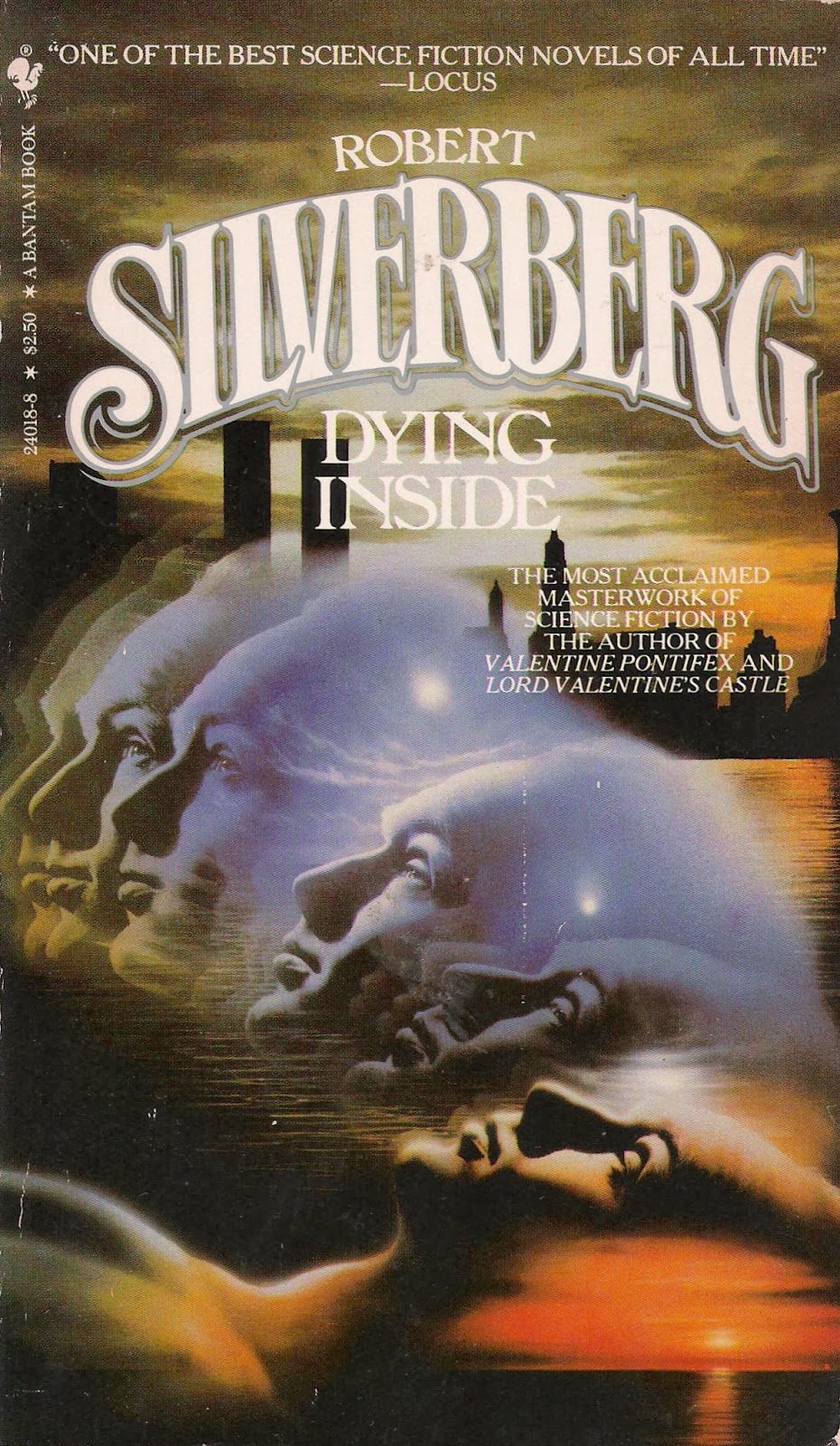
Dying Inside


Robert Silverberg Dying Inside (1972)

Apparently the novel Dying Inside is one of his very best, I wrote whilst reviewing Silverberg's Sunrise on Mercury collection back in July 2009, and despite slightly less than amazing fare here, the good bits are strong enough to suggest it's probably worth a look.

So here I am, having at last encountered a copy in a book store; and actually yes, it is pretty damn good, and quite literary in a way that's fairly rare for a science-fiction novel. Set in 1970s New York, Dying Inside has all the gritty, smelly texture of an autobiography but for the detail of its protagonist, David Selig, being a telepath and thus able to read the contents of other peoples' minds. However, rather than being a superman in the traditional sense, he is a neurotic, slightly pitiful individual now crippled by the horrifying realisation that his telepathy is fading, leaving him in some sense alone in what would be a void but for his own thoughts. The novel is roughly a metaphor for the ageing process, or at least certain aspects of the ageing process experienced once youth becomes only the memory of a different state of being - almost a mid-life crisis book. That said, as a metaphor, it's a little confused. All of David's knowledge and experience, his own unique advantage, has served only to wear him down, to grind him into a bitter, slightly paranoid figure contrasting sharply with the few other telepaths he encounters, all of whom seem to have done very well with their respective gifts. In several passages this process is defined as entropic:

Now comes a dark equinox out of its proper moment. The bleached moon glimmers like a wretched old skull. The leaves shrivel and fall. The fires die down. The dove, weary, flutters to earth. Darkness spreads. Everything blows away. The purple blood falters in the narrowing veins; the chill impinges on the straining heart; the soul dwindles; even the feet become untrustworthy. Words fail. Our guides admit they are lost. That which has been solid grows transparent. Things pass away. Colours fade. This is a gray time, and I fear it will be grayer still, one of these days.

The potential contradiction here is that whilst David succumbs to entropy as he sees it, the degradation and reduction of information to noise, his life as a mind-reader has been shaped by an unreasonable surfeit of information none of which has really done him any good. So whilst our man perceives a breakdown of the systems of his life as essentially entropic, it's actually more like an overload:

How they all hated me for my cleverness! What they interpreted as my cleverness, that is. My sly knack of always guessing what was going to happen. Well, that wouldn't be a problem now. They'd all love me. Loving me, they'd beat me to a pulp.

This is possibly why there were points at which Dying Inside struck me as a variant on Sartre's Nausea, and also points at which I wondered if the telepathic element was really essential to the story. The only significant difference between Silverberg's Selig and Sartre's Roquentin is, I would argue, that while the former experiences anxiety over the individual details from which his life is formed, the angst of the latter is inspired more by the life itself, if that makes any sense whatsoever. The distinction is subtle, and perhaps not easily made given that Dying Inside lacks the focus of Nausea, although the two novels do seem to have something in common, not least thematic depth.

The only real problem with Dying Inside would appear to be the character of Yahya Lumumba, a young black student who enlists Selig's services in the completion of an end of term paper. The depiction of this character seems astonishingly racist - references to hypothetical watermelon consumption being the least of its crimes. The inference is that Selig himself harbours racist views, but it's difficult to tell how much of it is Selig and how much is Silverberg, particularly with the narrative switching from third to first person and back again every few pages; and it seems additionally dubious that Selig's telepathy reveals Lumumba's innermost thoughts as stereotypical blaxploitation jive talk about white honkey crackers, unless the point here is that Selig's telepathy reveals nothing of use, as already suggested. In this respect the passages with Lumumba are difficult to evaluate, and whilst they may not exactly spoil the novel, in the absence of any better idea regarding the author's intention, they certainly jar, although maybe that is the point.

Dying Inside falls short of perfect, but it's not difficult to see how it has earned its reputation as a classic of the genre.

Friday, 12 October 2012

Nausea


Jean-Paul Sartre Nausea (1938)

Driving back from CD Exchange I slipped on my newly purchased Lazer Guided Melodies by Spiritualized, skipping straight to the sublime 'Shine a Light' which I hadn't heard in many years. Completely unexpected, as the track played I was in tears, and I realised I hadn't listened to this album since my friend Andrew died in February 2009. Andrew had taped it for me, along with the music of many other artists who became firm favourites and whom I never would have listened to but for his recommendation. He was a good friend, a huge and positive influence during a slightly crappy period living in south-east London, and I would do absolutely anything were it possible to bring him back and give him the life he should have had rather than the one he ended up with.

I first read Nausea because Andrew insisted I read it, explaining that it was quite unlike any other novel. I've now read it five or six times and I'm still not sure what to make of it, or at least whether there's anything to make of it beyond that which has already presented itself. My first impression was that Nausea might to some degree describe what it was like being Andrew at least part of the time, and I found the novel dense and difficult. Then, during one of those days so bad that you can no longer even be bothered to feel pissed off, it suddenly made absolute sense, and telling this to Andrew, he agreed that a very specific frame of mind is necessary for full appreciation of Sartre's debut novel. I've re-read a few times since, and it's always been the same, always dependent on one being just the right hue of something or other that isn't exactly melancholic.

Sartre's Antoine Roquentin lives a solitary existence, sat alone in a cafe or bar, occasional conversations with a self-taught acquaintance whom he doesn't really like that much, and an increasing sense of repulsion, a sense that no object or event is a thing in itself, and that all is tainted by his own understanding - yer basic existential nausea, not to be confused with anything so obvious as self-hatred. I could have a go at getting into the details but it would probably be easier if you just read the book, keeping in mind that it works best when approached from a quite specific perspective, and will probably never be adapted for the big screen with Bruce Willis playing the pensive historian Roquentin.

This time, for some reason, Nausea works despite my being generally happy. Possibly it feels like I'm reading Andrew's biography. The themes are soft but profound, and far too subtle for anything that could be distilled into a neat sentence upon a Wikipedia page, which is I suppose why Nausea is a novel rather than a manifesto.